Articles
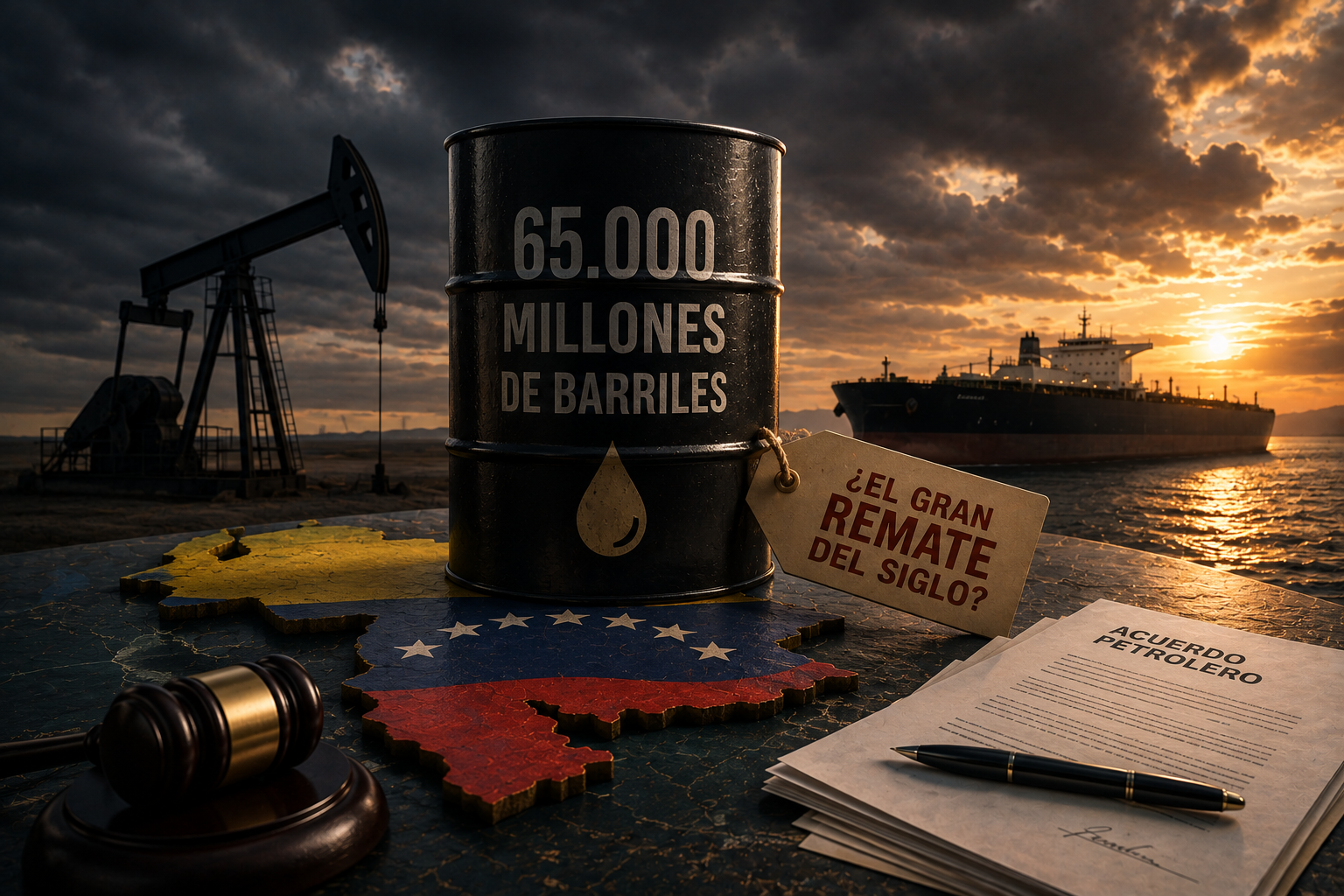
65 billion barrels: the great fire sale of the century?
What the new oil deal between the United States and Venezuela involves
Sovereignty has become a vintage word not only for Venezuela but for a world (and its people) increasingly pragmatic about nationality and borders, since these now seem to be defined more by money than by where one is born or has chosen to live.
On Friday, August 28, we witnessed up close the largest and boldest corporate spectacle in energy history: the administration of Donald Trump and the government of acting president Delcy Rodríguez signed a hydrocarbons pact worth more than 4 trillion dollars, more than twice the GDP of Brazil and Argentina, the largest economies in the region.
This is not a simple memorandum of understanding or a “little deal” for the temporary supply of Venezuelan oil to the United States. As a country, Venezuela is handing over 55% of the operational control of 65 billion barrels of Venezuelan crude to a select group of American private companies.
The energy agreement establishes a concession, or what it has officially been called, a “strategic risk-sharing partnership,” with a 25-year term, covering 17 oil blocks strategically located in the Orinoco Oil Belt and in the Lake Maracaibo basin.
The 65 billion barrels represent 21.5% of Venezuela’s total reserves (estimated at 303 billion) and, for Washington, increase the proven reserves of the United States by 141%, which were put at 46 billion barrels in 2024.
With this unprecedented economic move, Trump not only ensures cheap gasoline for his voters but will also more than double the United States’ “energy cushion” at a stroke. A good talking point ahead of the midterms, no?
From a Venezuelan nationalist perspective, the shift forced by the United States toward an extractivist model for Venezuela is dismal. Likewise, the shattering of the dream of oil sovereignty and economic diversification that has lived in the imagination of Venezuelans since the nationalization of the oil industry in 1976 can be frustrating. But the reality is that the country today lacks the investment capacity required to substantially increase crude production and rebuild our tarnished economy. In this sense, the oil deal provides for investment by North American operators of 100 billion dollars in capital expenditure (capex), money Venezuela does not have today, which will allow production to rise by 1.5 million extra barrels per day in the medium term.
The oil deal in figures
· At a reference price of 65 dollars per barrel, the deal amounts to 4.225 trillion dollars (trillions, in English).
· The unassailable advantage for Caracas lies in a commitment from Washington to inject capital (capex) of about 100 billion dollars and operating expenditure (opex) of nearly 135 billion over the life of the agreement.
· This pact appears to be the only pragmatic route to reverse the structural inertia that kept PDVSA stuck between 900,000 and 1.2 million barrels per day (bpd), and to reach the historical production potential of more than 3 million bpd that Venezuela once had.
Under the oil pact, the foreign operating companies will assume 100% of the financial risk, sparing the Venezuelan state from taking on debt or issuing sovereign guarantees. In exchange for this capitulation, Venezuela expects to receive about 19 dollars per barrel in net and direct profit (30% of the sale price), which would leave the astronomical sum of 209 billion dollars in tax revenue for the Venezuelan government over the life cycle of the project.
Is the oil deal a bitter pill for nationalism? Without doubt, since we are ceding technical and operational governance and the marketing of crude to multinationals, which implies admitting, in some way, a failure in managing our hydrocarbons industry. Yet the undeniable advantage is that this agreement stands as a lifeline against an economic model that is undoubtedly obsolete today. Without the intensive enhanced-recovery technology these consortia bring to reactivate mature fields (brownfields) and develop new ones (greenfields), Venezuelan oil was condemned to remain underground, losing all its value in the imminent era of the global energy transition.
AI-generated image.