Articles
US wrests Venezuelan oil from China
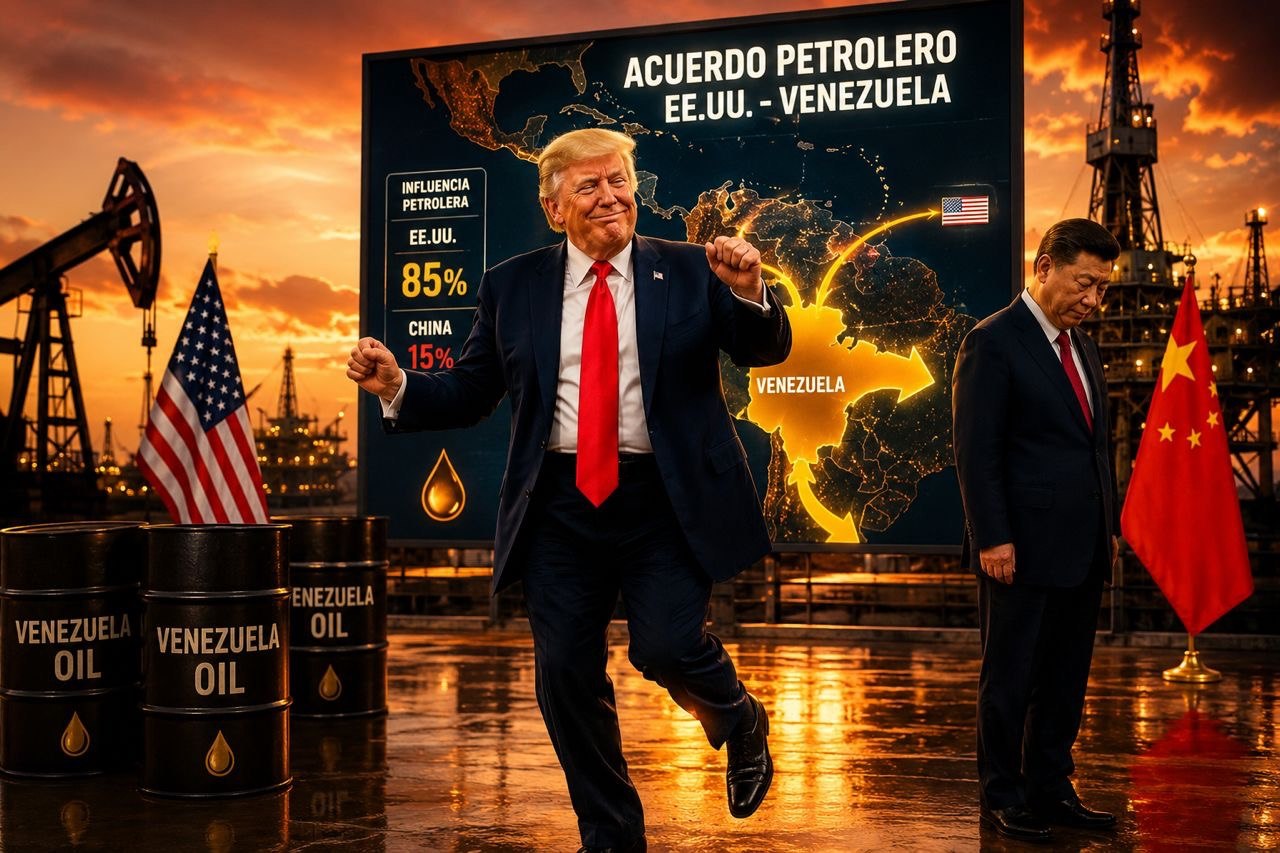
The geopolitical board has just registered one of its most aggressive maneuvers in decades. With the announcement of the mega oil pact between the administration of Donald Trump and the government of Delcy Rodríguez, which grants the United States control and exploitation of 17 strategic fields equivalent to 65 billion barrels of crude for a period of 100 years, the White House is not only pursuing local economic benefits. The true underlying objective is of a global strategic nature: to displace Beijing's financial and energy presence in the backyard of the Americas.
For more than two decades, China consolidated a dominant position in Venezuela thanks to a policy of oil-backed lending that made Caracas its largest creditor in Latin America. However, Washington's recent pragmatic shift cuts short Asian hegemony in the Orinoco basin. By securing 55% of the effective output of this new energy consortium and a preferential right to purchase at cost, US diplomacy will not only supply its strategic reserve; it is building a commercial wall that leaves Chinese state-owned companies (such as CNPC) relegated to a secondary role in Venezuela's energy scheme.
China's sidelining reflects an inexorable logic of market and power. While the Asian giant financed projects through an opaque sovereign debt that ended up buried by the inefficiency and operational collapse of the local industry, Washington offers a massive influx of private capital, critical infrastructure and direct refining channels on the Gulf Coast. Faced with the promise of an injection approaching $100 billion to revitalize national production, the political leadership in Caracas appears willing to reconfigure its international loyalties, relegating its historical debt to Chinese state banks to second place.
The dilemma for Xi Jinping is extremely complex. Beijing finds itself trapped between two bad scenarios: aggressively demanding payment of its past debts and risking a formal rupture with Caracas, or passively accepting that the United States take the helm of the largest energy resource on the planet a few kilometers from its land borders. Having fallen behind in the allocation of the most lucrative fields and without the capacity to veto US control over transport and export infrastructure, China's geopolitical influence in northern South America is suffering an unprecedented structural setback.
What the hemisphere is witnessing is not simply an agreement on barrel prices or operating licenses, but the deployment of a real-time policy of diplomatic containment. By forcing a direct alliance between American capital and the de facto power in Caracas, Washington manages to weaken the Beijing-Caracas axis, reaffirm its hegemony in the Caribbean basin and send an unmistakable signal to rival powers: the strategic resources of the Americas will once again be governed by the parameters of Western pragmatism.