Articles
Consumption as the pulse of life: From competitive abundance to rebuilding welfare in Venezuela
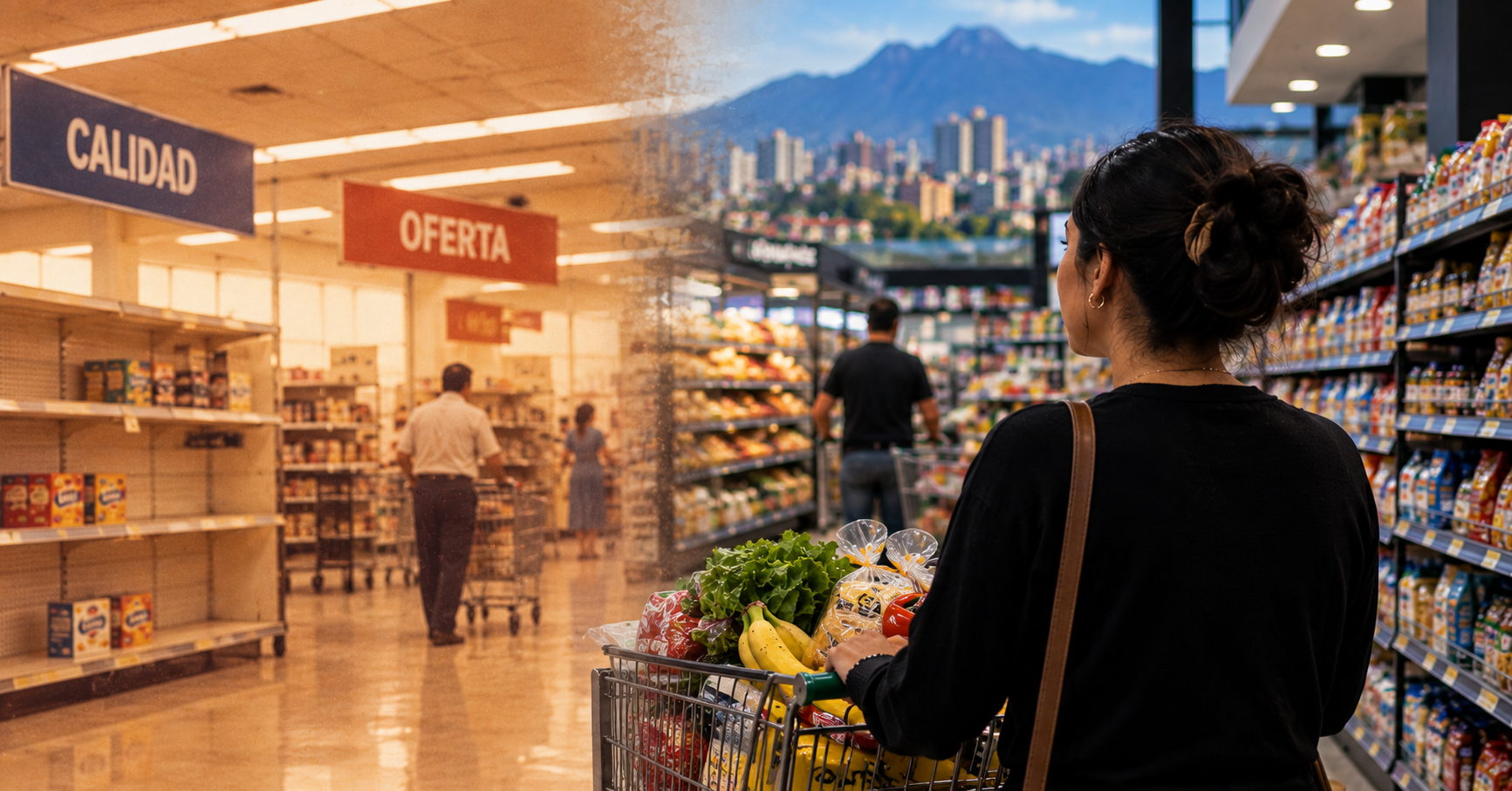
In contemporary economic narratives, consumption is often mistakenly reduced to a mere statistic within gross domestic product or to a manifestation of empty consumerism. Yet in a deep analysis of social welfare, the capacity to consume is the most reliable and tangible indicator of a nation's development. When a family moves beyond the anxiety of daily subsistence and manages to acquire goods that raise its quality of life, it does not merely meet material needs; it exercises a fundamental form of freedom. In Venezuela's historical course, the evolution of consumption patterns has been the most faithful mirror of its moments of splendor, its sharpest crises and its inevitable lessons about how markets work.
To understand the significance of consumption as a measure of development, it is necessary to observe the everyday life of the citizen. A country's development is not verified solely in large infrastructure projects or in the rhetoric of official reports, but in real purchasing power and equitable access to a diversified supply of goods. A healthy level of consumption reflects decent wages, confidence in the future and monetary stability. When household income allows families to plan, save and choose, the economy enters a virtuous circle in which demand stimulates private investment, investment generates productive jobs, and industrial activity flourishes to satisfy an increasingly demanding consumer.
Venezuela's collective memory preserves the era in which this dynamic reached its fullest everyday expression through a vibrant and competitive retail network. The country's supermarkets, hypermarkets and stores were not mere warehouses of merchandise but settings of abundance, where domestic production and international supply coexisted in a fascinating balance. That unrestricted competition generated an ecosystem of tangible benefits for society. On the one hand, local industry was spurred to raise its standards of quality, packaging and efficiency in order to compete head-to-head with established global brands. On the other hand, the need to win over the public's taste fostered a highly developed and creative advertising industry, which not only fed television, radio and the press but also energized agencies, designers and media outlets, generating thousands of indirect jobs.
Yet the most transformative pillar of that period of social mobility was mass access to credit for consumption. The financial system functioned as a true catalyst for progress. Credit cards, personal loans and mortgages were not seen as emergency mechanisms for buying basic food, but as levers for building the future. Credit democratized prosperity, enabling middle-class and working-class families to buy their own homes, equip their households with durable appliances, renew vehicles and finance their children's higher education. The ability to buy on installment provided certainty and allowed today's labor to turn into wealth for tomorrow.
The dramatic unraveling of this economic model, following the prolonged application of exchange controls, arbitrary price setting, expropriations and measures that starved the productive apparatus, brought the erosion of purchasing power and the collapse of bank credit. The subsequent hyperinflation pulverized the national currency and, with it, the capacity to save. Prolonged scarcity abruptly erased consumer sovereignty: the ability to choose among brands and qualities was replaced by the anxiety of finding whatever was available. In that setting, advertising lost its meaning, competition disappeared and consumption shrank to its most primary and dramatic expression, demonstrating that without free markets and macroeconomic stability there is no possible development.
The more recent developments in Venezuela's situation, characterized by de facto dollarization and the revival of commerce, have returned supplies to store shelves and allowed the resurgence of brands and private initiatives. Nonetheless, rebuilding comprehensive welfare still requires overcoming deep structural gaps. The gradual reappearance of short-term financing mechanisms suggests a social desire to recover credit, but genuine development will require the full restoration of a solid banking system, the stabilization of real income and the strengthening of domestic production against imports.
The act of going to the supermarket and filling the cart with quality products, freely chosen and paid for with the fruits of stable work, is not a superficial privilege; it is the most basic expression of human dignity and the unmistakable sign of a healthy society. Venezuela has learned from its recent history that prosperity is not decreed by law or handed out through subsidies, but built by guaranteeing conditions for investment, transparent competition and trust. Restoring a dynamic market in which credit fuels families' dreams and industrial excellence competes for the public's preference remains the surest path toward the sustainable development the country deserves.