Articles
The dilemma of the knee: What the execution of Mance Rayder in Game of Thrones teaches us about politics in Venezuela.
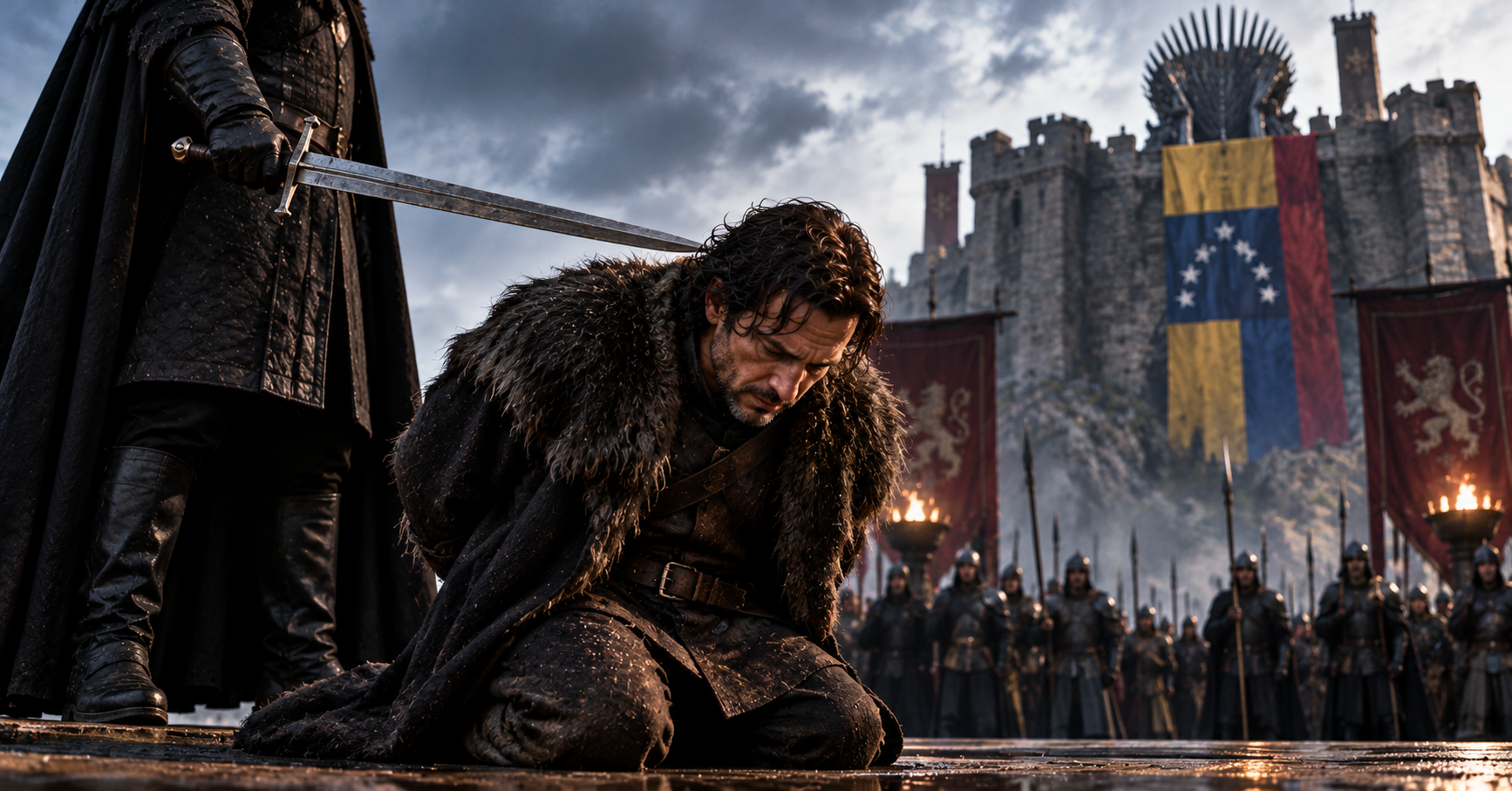
In the moments before his execution, ordered by Stannis Baratheon, a king desperate for legitimacy, Mance Rayder, the man who united the free peoples without inheriting a throne and who managed to build his legitimacy from below, engages in a masterful dialogue with the self-made man, Jon Snow. Stannis demands an elementary yet absolute symbolic act: kneel in exchange for submission and integration into the ranks of a king. Mance would obtain from this gesture the salvation of his life and the integration of his people into warmer lands ahead of the approaching winter. Jon Snow, guided by a consequentialist and utilitarian vision, challenges him: “You united ninety clans... Isn’t their survival more important than your pride?”. Mance, unmoved by this, replies bluntly: “Pride? To hell with my pride... They followed me because they respected me and because they believed in me. The moment I kneel before a king of the South, all of that disappears”. In the end, Mance caps his philosophy with a declaration of absolute self-determination: “The freedom to make my own mistakes is all I ever wanted.”
This exchange condenses one of the great tensions of universal political thought: the eternal struggle between the ethics of conviction and the ethics of responsibility, formulated by Max Weber in Politics as a Vocation (1919). While Jon Snow embodies the pragmatic view of politics, in which preserving life justifies accommodation with established power, Mance represents the constitutive value of legitimacy of origin and of exercise. For the leader of the Wildlings, authority does not reside in a dynastic title, nor is it inherited by decree; it resides in an unwritten pact of trust between the leader and his community of followers. Kneeling is not a simple strategic gesture: it is the ontological dissolution of his leadership. It is the death of trust.
From the standpoint of social psychology and political philosophy, the scene lays bare the fundamental difference between coercion and authority. Michel Foucault, in Society Must Be Defended (1976), argues that power is not an object that is possessed but a network of asymmetrical relations that are exercised. Stannis possesses brute force, the sword and fire, yet he lacks the capacity to bend Mance’s will. The paradox of the tyrant is that when the subordinate decides he prefers death to submission, force ceases to function as an instrument of persuasion.
Hannah Arendt, in On Violence (1969), observes that violence appears precisely where legitimate power is at risk of disappearing. How many times have we seen this in Venezuelan politics? A brief question for reflection. Stannis needs Mance’s genuflection because the submission of the leader legitimizes the domination of the sovereign. Mance understands that legitimacy is fragile: once the leader betrays the integrating principle that gave him origin, as is the case here, the absolute freedom of the clans against southern absolutism, the social cohesion of his people crumbles. Thus, the refusal to bend the knee is not mere individual stubbornness or “toxic radicalism” if we put it in more Caribbean terms; it is a measure to protect the collective identity of the community he represents, a situation that carries a high political cost for a matter of survival.
When transposed to Venezuela’s contemporary political history, the dilemma between Mance Rayder and Jon Snow ceases to be television fiction and becomes a faithful portrait of the historical and national crossroads of our country. Venezuelan politics has continually oscillated between two opposing impulses: the accommodating pragmatism labeled “collaborator-accomplice” and the intransigent resistance labeled “stubborn radicalism.”
At various moments of political crisis, opposition forces and civil society institutions have been presented with the equivalent of Stannis’s proposal: join the institutional design of the regime, sign agreements of peaceful coexistence, or give up essential democratic principles in exchange for room to maneuver, electoral participation or relief from pressure. A complex dilemma, a play of decisions and high costs. Even so, in politics one always has to decide something. In mass behavior, political disillusionment does not necessarily stem from defeat in a battle but from the loss of moral reference points among those who lead. When society perceives that its leaders give way to the adversary’s normative framework, social anomie and apathetic withdrawal into the private sphere follow. This has already happened in the past: some leaders “kneel,” others even kiss the hand, but in the medium term their political capital dilutes over time. They cease to be a reference within the worldview of “struggle” and become passive supporting actors in the system, mere avatars, trading cards or memes circulating on social networks.
The exchange analyzed in Game of Thrones leaves us a crucial lesson about the limits of pragmatism. In political practice, pragmatism without principles degenerates into mere complicity and, in some cases, corruption. Here, the scheming known in Venezuela as alacranización falls short, while principle devoid of strategy risks becoming fruitless martyrdom, an unsustainable heroism that rests solely on epics, slogans and interviews laden with promises for an expectant audience. The challenge for Venezuelan political culture is to overcome this reductive false dilemma.
To build a real democratic horizon, citizens and their leaders must understand that true capitulation occurs when they accept the language, conditions and ethical limits imposed by hegemony or by the ruling class, which better understands this dynamic of power.
Mance Rayder chose to face the fire rather than legitimize with his head a system of domination he loathed. The challenge for Venezuela today is to understand that freedom is not negotiated on the exact terms of power. Pushing against the walls of the political stage means refusing to repeat the script of resignation and recognizing that building a new country will only be possible if collective dignity is preserved as a non-negotiable principle, but without this meaning that an entire country is thrown into the bonfire.