Articles
The OFAC license maze: what changes and what stays on Venezuela's energy board
This study analyzes the operational and structural implications of the eight general licenses amended by the U.S. Office of Foreign Assets Control (OFAC) on August 27, 2026. Through a detailed examination of the authorizations, exclusions and compliance costs, it assesses how this scheme of relaxed restrictions conditions Venezuela's economic sovereignty, limits local industrial development with added value, and favors market concentration in large multinational corporations.
This analysis was written by an artificial intelligence system under the direct supervision of the SurEconomics editorial staff.
What an oil company can do today and what remains prohibited
The amendment of the general licenses by OFAC on August 27, 2026 introduces specific changes to the operating framework of authorized companies. According to the official OFAC text, eight amended general licenses were issued: General License 46D, General License 47B, General License 48C, General License 50C, General License 51C, General License 52B, General License 54B and General License 61A. In addition, two new frequently asked questions (numbers 1267 and 1268) were published, two others (numbers 1233 and 1244) were amended, and number 1260 was archived.
According to reports from the outlet La Patilla, General License 50C authorizes oil and gas sector transactions in Venezuela for six specific companies and their subsidiaries: BP PLC, Chevron Corporation, Eni S.p.A., Établissements Maurel & Prom SA, Repsol S.A. and Shell PLC. General License 46D, meanwhile, applies to U.S. companies established before January 2025.
Despite these openings, the fundamental prohibitions remain in force. Authorized companies are prohibited from conducting transactions with Russia, Iran, North Korea and Cuba. Likewise, payments in gold and in cryptocurrencies (including the petro) remain prohibited, as does the use of blocked vessels.
The exclusion of exploration and extraction in mining
General License 51C authorizes certain activities involving minerals of Venezuelan origin, including gold. However, according to La Patilla, this license explicitly excludes exploration, extraction and the formation of new joint ventures within Venezuela. The authorization is limited solely to processing, refining and marketing.
This limitation has a direct impact on the local value chain. By preventing the country from developing and controlling the initial stages of exploration and extraction under new partnership schemes, the capacity to retain the value generated by natural resources within national territory is restricted. The authorized stages (processing and marketing) are subordinated to a scheme in which primary control of the resource remains under the influence of external regulations, limiting the development of a sovereign mining industry.
The prohibition of new joint ventures
A common element in the most recent licenses, such as 51C for minerals and 61A for telecommunications (the latter focused on internet, satellites and submarine cables), is the exclusion of new joint ventures. Joint ventures represent a long-term partnership mechanism that requires the integration of capital and the transfer of technology under local legislation.
By prohibiting the formation of these entities, the government of the United States prevents permanent structural alliances from consolidating between international capital and the Venezuelan state. This keeps the commercial relationship at a purely transactional and temporary level, preventing Venezuela from using its resources to negotiate technology transfers or fixed capital investments that would permanently strengthen its industrial infrastructure.
Compliance costs as a barrier to entry
Seven of the eight licenses issued require authorized companies to submit detailed reports directly to OFAC, and not to the Venezuelan government. In these reports, corporations must declare the parties involved, the goods, the quantities, the values, the dates and any payment made to the government of Venezuela. General License 51C also requires strict documentation of the chain of custody, with a first report within ten days of the first operation and then every thirty days.
This level of administrative oversight generates an extremely high compliance cost. Only large multinational corporations have the legal, financial and audit departments needed to meet these requirements without compromising their profitability. For small and medium-sized enterprises, this cost acts as an insurmountable barrier to entry, resulting in the concentration of the energy and mining market in the hands of a few global players.
The revocability of licenses and the investment horizon
A general license is, by definition, a unilateral and temporary administrative permit. It can be revoked or modified at any time by the U.S. Department of the Treasury. This precarious nature severely conditions the investment horizon of companies.
Energy infrastructure projects require massive capital investments with medium- and long-term payback periods. Under the constant threat of sudden revocation, international companies tend to prioritize rapid extraction and immediate marketing operations, avoiding committing capital to long-range social or industrial development projects. As context for the sector, the daily El Nacional reported that Pdvsa plans to incorporate methane gas into the thermoelectric system by year-end, estimating a delivery to the domestic market of around 2 billion cubic feet of gas by December 2026, a national planning effort that contrasts with the instability of the external licensing scheme.
Critical space: Conditioned sovereignty and limited development
The detailed analysis of the OFAC amendments shows that we are not facing a lifting of sanctions, but rather a highly regulated and conditioned mechanism of relaxation. Venezuela's economic sovereignty is subordinated to administrative decisions made in Washington, which determine which companies may operate, under what conditions and in which sectors.
Although it is mitigated by the elimination of the requirement that authorized contracts be governed by U.S. law, the obligation to resolve any legal dispute in foreign jurisdictions such as the United States, the United Kingdom, France or Singapore maintains an evident loss of jurisdictional sovereignty. Control of the country's strategic resources continues to be used as an instrument of geopolitical pressure, limiting the state's capacity to plan its economic development autonomously and sovereignly.
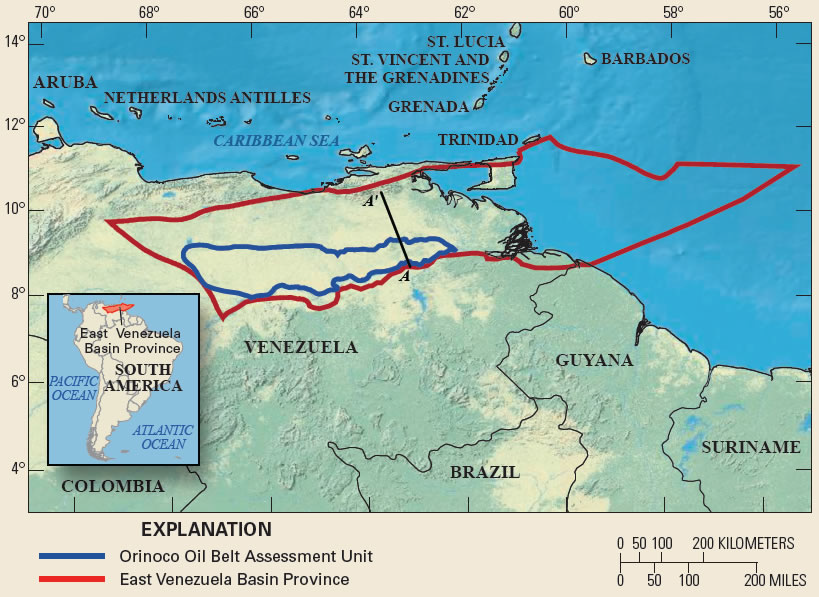
File photo, 2009. Map of the Orinoco Oil Belt. Photo: Christopher J. Schenk (USGS), public domain, via Wikimedia Commons.