Articles
Western fear of Chinese cars and the sad farewell to the myth of the "free market"
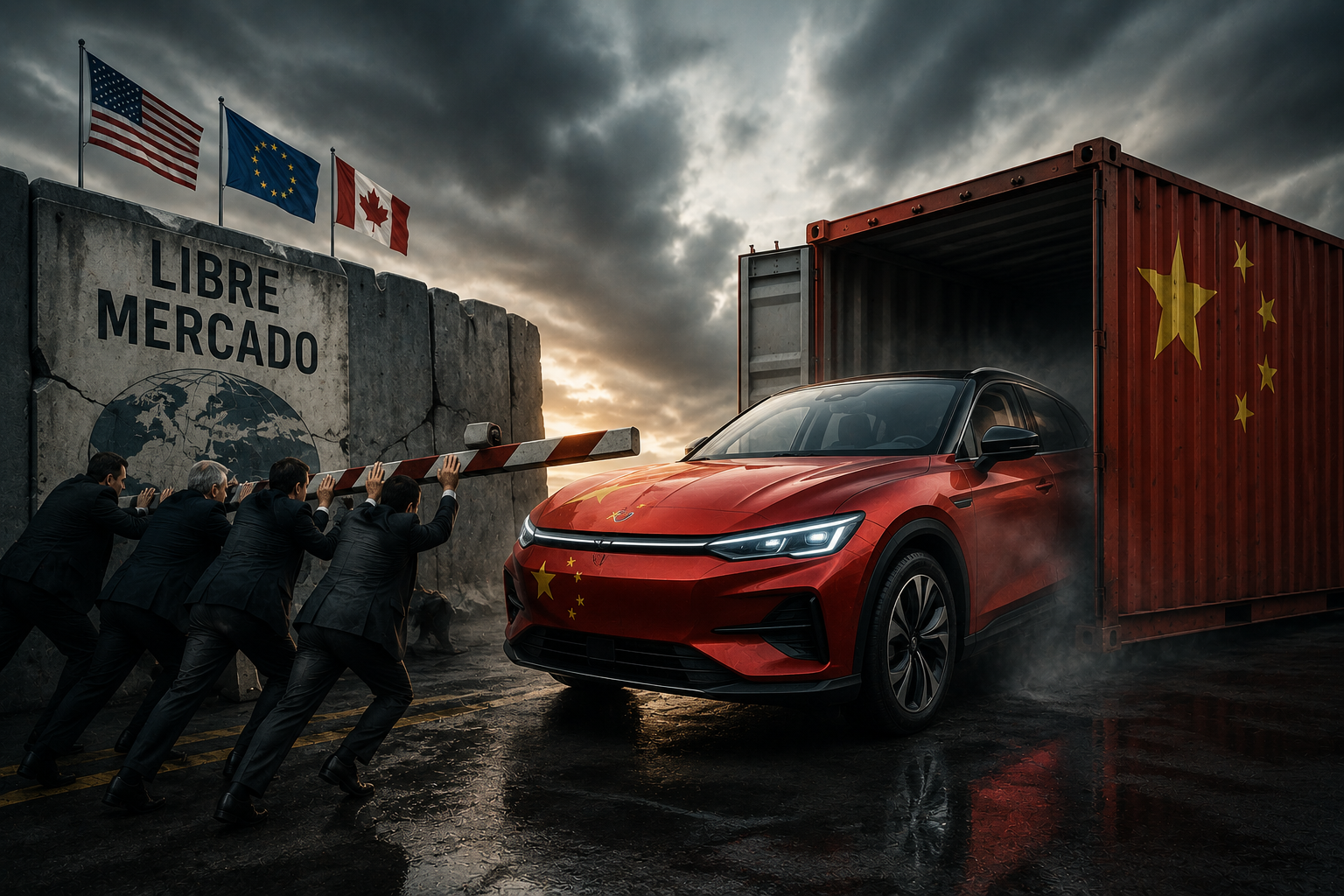
For more than forty years, economics professors trained at the Ivy League universities, the most elitist private institutions in the United States, solemnly told us that "perfect competition" and the "free market" were sacred, untouchable dogmas.
We were told that the invisible hand of capital should regulate everything, that the state was a terrible manager, and that customs barriers had to be torn down to lower prices for consumers. But woe to the free market when the winners are not Western corporations!
It turns out that the engineers in Beijing and Shanghai did not waste time on theoretical speeches. Thanks to a planned public strategy backed by the People's Bank of China (PBOC), the country's central bank, which injected a massive credit line of 1.20 trillion yuan (about $168 billion) into semiconductors and energy storage, the Asian giant learned to manufacture high-tech electric vehicles 40% cheaper than those produced by Tesla, Renault or Ford. And what was the reaction of the "free democracies" of the West to this lesson in efficiency? They threw the theory of the free market into the trash.
The United States has just imposed a punitive 100% tariff on Chinese electric cars, while the European Union has approved barriers of 38%. The protectionist hypocrisy of the Global North has been laid bare: free trade was only wonderful when American and European multinationals sold their products at inflated prices in the Global South. As soon as China showed that industrial planning, with state investment and public control, can beat speculative capitalism, the developed countries raised trade walls. The lesson for the world is clear: pure free markets are a tale for the naive; the countries that prosper are those that plan and defend their domestic production.
In this dispute, our region finds itself on the very front line of the geopolitical struggle. As Washington and Brussels close their ports to Chinese electric cars, the Chinese giant's brands are directing all their commercial firepower toward Latin America's emerging markets. Countries such as Brazil, Mexico, Chile, Colombia and Peru are being flooded with state-of-the-art Chinese vehicles at highly competitive prices, which democratizes access to clean electric mobility for the middle class and urban public transport. However, the latent risk is falling back into a position of subordination: while we buy finished technology from China, Beijing demands a massive, uninterrupted supply of Chilean and Peruvian copper, as well as Argentine and Bolivian lithium. The key implication is that Latin America must not limit itself to being the playing field where China sells cars and extracts minerals; our governments must require Chinese firms to set up assembly plants, battery manufacturing and technology research centers on Latin American soil, using this global competition to industrialize our own economies.