Articles
The Truman Show and the great trap of Venezuelan politics
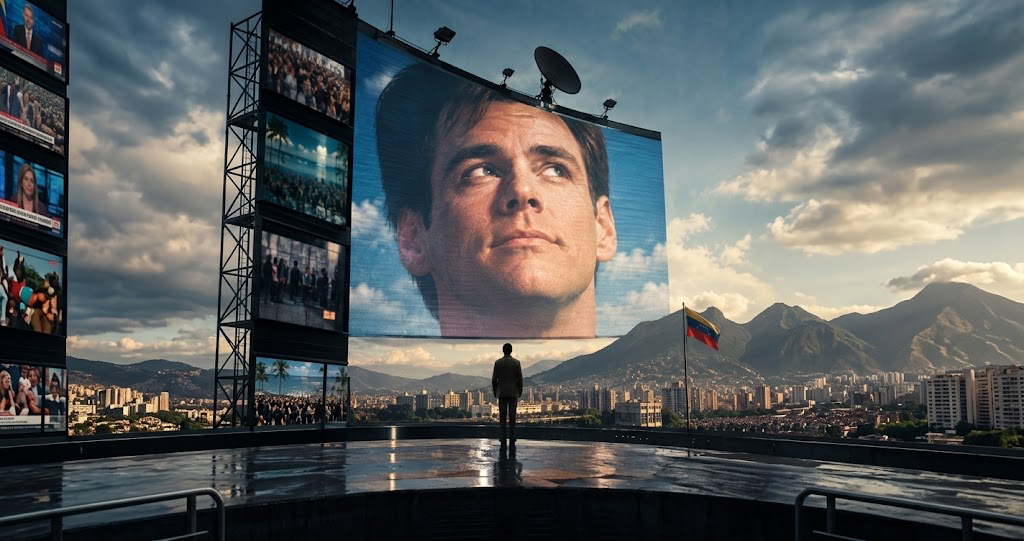
In the film The Truman Show, Christof, the director who pulls the strings of the protagonist's life, delivers a heartbreaking and perfect line: “We accept the reality of the world with which we're presented. It's as simple as that”. It is a relentless lesson about how power works. Truman Burbank lives trapped in a perfect set called Seahaven, a town built under a simulation, with actors who believe their life is real, when in fact every corner, every sudden rainstorm and every conversation is meticulously scripted. Looking at Venezuela's recent history, it is impossible not to feel that we have been the unwitting protagonists of our own television studio.
For years, Venezuelan politics has been built as a monumental exercise in simulation. What communication theory has termed communicational hegemony has been nothing more than the state's attempt to erect a giant dome over society. In the digital age, Seahaven's dome has grown more sophisticated: it is no longer built solely with censorship and traditional imposition, but with the invisible architecture of the virtual space that everyone knows and carries in their pocket. Venezuela's social media ecosystem has functioned as an environment of algorithmization and polarization, where armies of bots, content farms and the manipulation of trends design a digital bubble tailored to each user. Like the curved mirrors of Truman's dome, this hyperconnected ecosystem generates echo chambers that reinforce biases, isolate people from empirical contrast and fragment public conversation. Walter Lippmann warned a century ago that people do not react directly to the real world but to the “pseudo-environment” that mediators construct in their minds; today, that pseudo-environment is recalibrated in real time by algorithms that decide which outrage to prioritize and which reality to render invisible.
No dome is held up by walls alone; it must be installed in people's minds. In the film, Truman is not held in place with chains but by having a paralyzing fear of water instilled in him through a fabricated childhood trauma. The social psychology of fear operates in exactly the same way in Venezuelan political discourse. The constant threat of chaos, destabilization or the impossibility of progress through solutions has worked as that impassable sea of Seahaven. Recall the speeches of Chávez and Nicolas Maduro about the opposition and the external enemy, the United States. Cuba has seen the same thing for more than 60 years. Noam Chomsky and Edward Herman explained that induced fear is the ultimate tool for achieving manufactured consent. When propaganda succeeds in making people feel that any attempt to look beyond the official version amounts to falling into the abyss, learned helplessness becomes the perfect mechanism of control. They persuade us that the routine of the studio set is better than the risk of freedom. Venezuela is a sad, experimental example of this: paralyzing fear and emotional dosing.
On top of this comes the complicity of the surroundings. Neighbors, coworkers and even Truman's wife are actors who repeat slogans, place advertising products in front of the cameras and simulate normality. Venezuelan society has seen a similar dynamic: adaptation out of sheer survival or socioeconomic convenience. Leon Festinger defined it very well with his theory of cognitive dissonance. When the reality you live every day collides head-on with the official version repeated to you on television, the mental strain is unbearable. To ease the pain a little, many prefer to fit into the script, smile at the camera and pretend that everything is going according to plan, turning public life into a collective theater. Exploring these themes can be painful, because it exposes society's vulnerability to the great apparatus of emotional manipulation built from the foundations of power and by those who stand behind it.
Yet artificial sets have one insurmountable problem: sooner or later they age and show their seams, and so does the discourse. In the film, Truman begins to awaken not because of some grand heroic act, but because of the system's small mistakes. A spotlight that suddenly falls from the blue sky, the director's voice bleeding through the radio frequency, passersby who walk in repetitive circles. In Venezuela, the fracture of the narrative did not happen overnight but through the accumulation of broken seams and contradictions that arose from a political dynamic of survival in which the ideological was just another simulation. When the gap between everyday life and the official discourse became enormous, propaganda lost its spell, because reality was scandalous enough and impossible to conceal. The arrival of the digital ecosystem and citizens' word of mouth ended up cracking the blue paint of the false horizon presented in The Truman Show. Jean Baudrillard said that when the simulacrum becomes imperfect, the illusion inevitably collapses. In this vein we can also recall other films such as The Hunger Games and the Apple TV+ series Silo.
The climax of The Truman Show is profoundly poetic and frightening. Truman sails to the edge of the map and the bow of his boat strikes the studio wall painted with clouds. He realizes his entire world was a lie, a cursed simulation that wasted his youth and his life for a long time. Christof, alluding to Jesus Christ, speaks to him from on high, offering him the security of the show and reminding him how cruel the real world is. Truman simply smiles, makes his characteristic bow and crosses the door into the unknown. Venezuelan politics stands precisely at that same door. Dismantling the narrative and ceasing to believe in the set is the first step, but crossing outward demands the courage to embrace uncertainty and begin, once and for all, to write one's own script, accepting the costs of something new.
Overcoming this dynamic requires far more than a simple change of actors on stage; it demands the conscious commitment to deconstruct the set from its foundations. Breaking the simulation means developing a critical outlook capable of doubting prefabricated certainties, questioning the algorithms that feed our packaged outrage, and distrusting the comforting narratives that invite us to resignation. Freedom does not begin when the regime changes its discourse, but the moment the individual citizen decides to stop being a passive spectator and dares to touch the seams of the narrative, asking uncomfortable questions and refusing to repeat the assigned script of manufactured opinion. We must embrace the uncertainty of the real world; it is the only worthy path to stop inhabiting someone else's fiction and finally begin to be the true authors of our collective destiny.