Articles
María Corina's absence and the energy pragmatism of the US
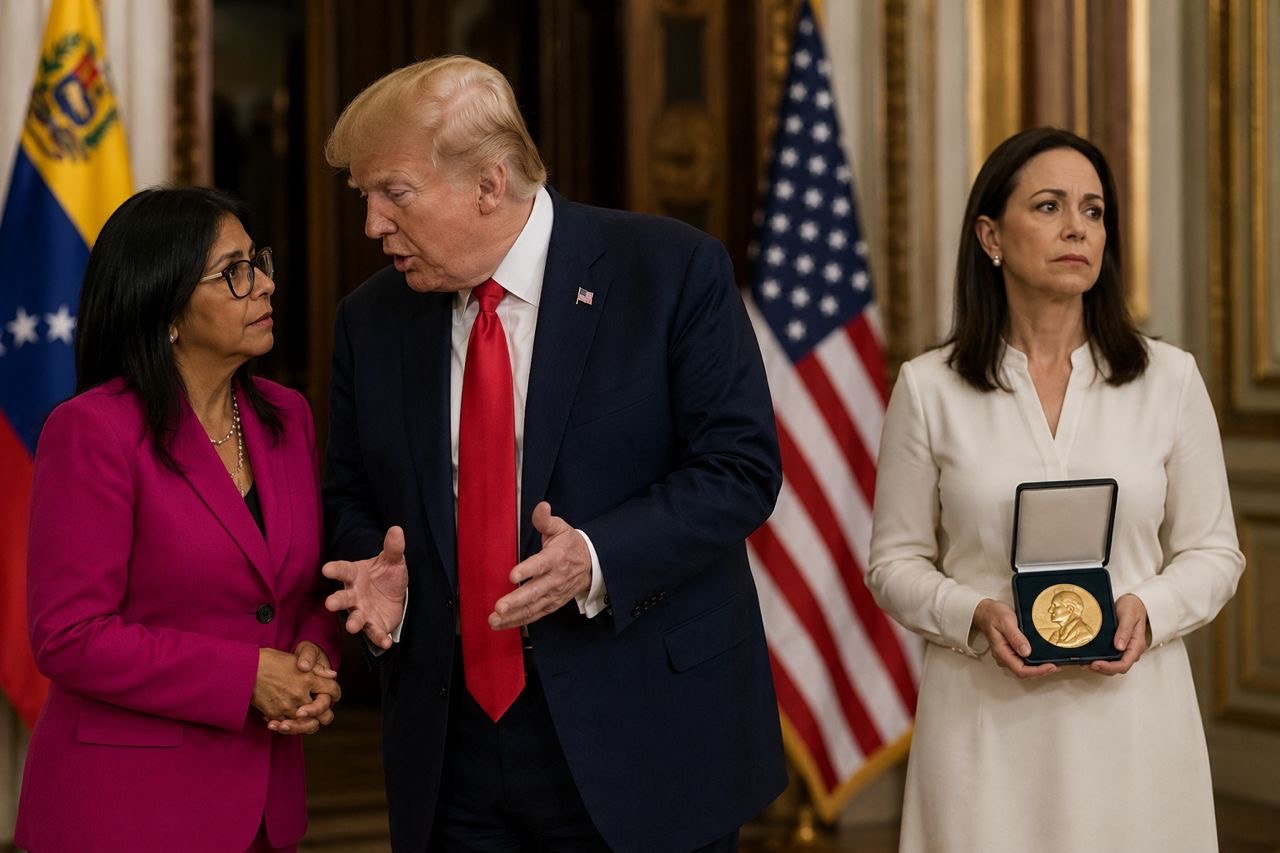
The Venezuelan political stage has just been shaken by a paradox as stark as it is predictable. While Washington and Caracas announce a historic energy deal under which the administration of Donald Trump and the government of Delcy Rodríguez plan to control and exploit reserves estimated at 65 billion barrels of crude, the opposition leader and 2025 Nobel Peace Prize laureate, María Corina Machado, continues to travel the world and plan her return to Venezuela through social media. The scene condenses the victory of pragmatism over principle: the same international actors that celebrated the capture of Nicolas Maduro on January 3 now prefer to negotiate direct supply contracts with the power in Miraflores.
Being far from the ground is never neutral in politics, and for María Corina that distance is beginning to carry a costly price. Venezuelan politics is not resolved in the drawing rooms of diplomats in Europe or in international press rooms; much less from a YouTube screen. It is resolved in the street, in the daily life of a country that is learning to survive through informal trade, de facto dollarization and everyday adaptation. Being outside Venezuela, the opposition leadership faces the imminent danger of becoming a voice of purely symbolic representation, and nothing more: a voice distant from people's immediate urgencies and without real capacity to mobilize or press on the reality inside the country. María Corina Machado is at her lowest political point. She looks weak, has no room to maneuver and is disconnected from reality.
The White House has once again displayed realpolitik without nuance. The oil agreement shows that, for US geopolitical interests, energy security and containing fuel prices weigh infinitely more than the agenda of democratization or the rhetoric of “virtue signaling”. The message sent from Washington is clear: support for human rights and for opposition figures is desirable in speeches, but deals are closed with those who hold the keys to the wells, with whoever holds real power over an oil-producing country, not with a Nobel laureate.
This realignment places Delcy Rodríguez in an unprecedented position of strength. Not only does she secure a crucial financial reprieve through the inflow of foreign capital and the massive marketing of barrels, but she gains something even more valuable: de facto validation as indispensable interlocutors and necessary power brokers for today's Venezuela. Before international markets, Rodríguez ceases to be a sanctioned figure and becomes the administrator of the resources that the great powers need, a political actor who gains more and more confidence not only from Trump but also from investors and major oil companies around the world. Delcy Rodríguez and her government now have a great opportunity to advance not only a large process of economic recovery but also a solid campaign of renewal of government structures, and that includes the communication and narrative aspects needed for an eventual presidential election.
María Corina Machado finds herself at a decisive crossroads, and within the opposition it has already become an uncomfortable matter for everyone. The symbolic capital she has accumulated and the international ethical backing remain intact, but they count for little when the political rival gains economic ground and operational legitimacy through oil and energy agreements. If the opposition movement fails to articulate a strategy that goes beyond dependence on Western diplomatic support, and does not weigh the political costs of contesting the space in person, it risks being relegated to a merely testimonial role in a Venezuela that has already begun to divide itself up without them. Today, a barrel of oil carries more weight than a Nobel Prize, although as far as we understand, María Corina Machado gave one to Donald Trump.