Articles
The fall of the tech giants
If the Fed raises interest rates, the share prices of the big technology companies could be pulverized
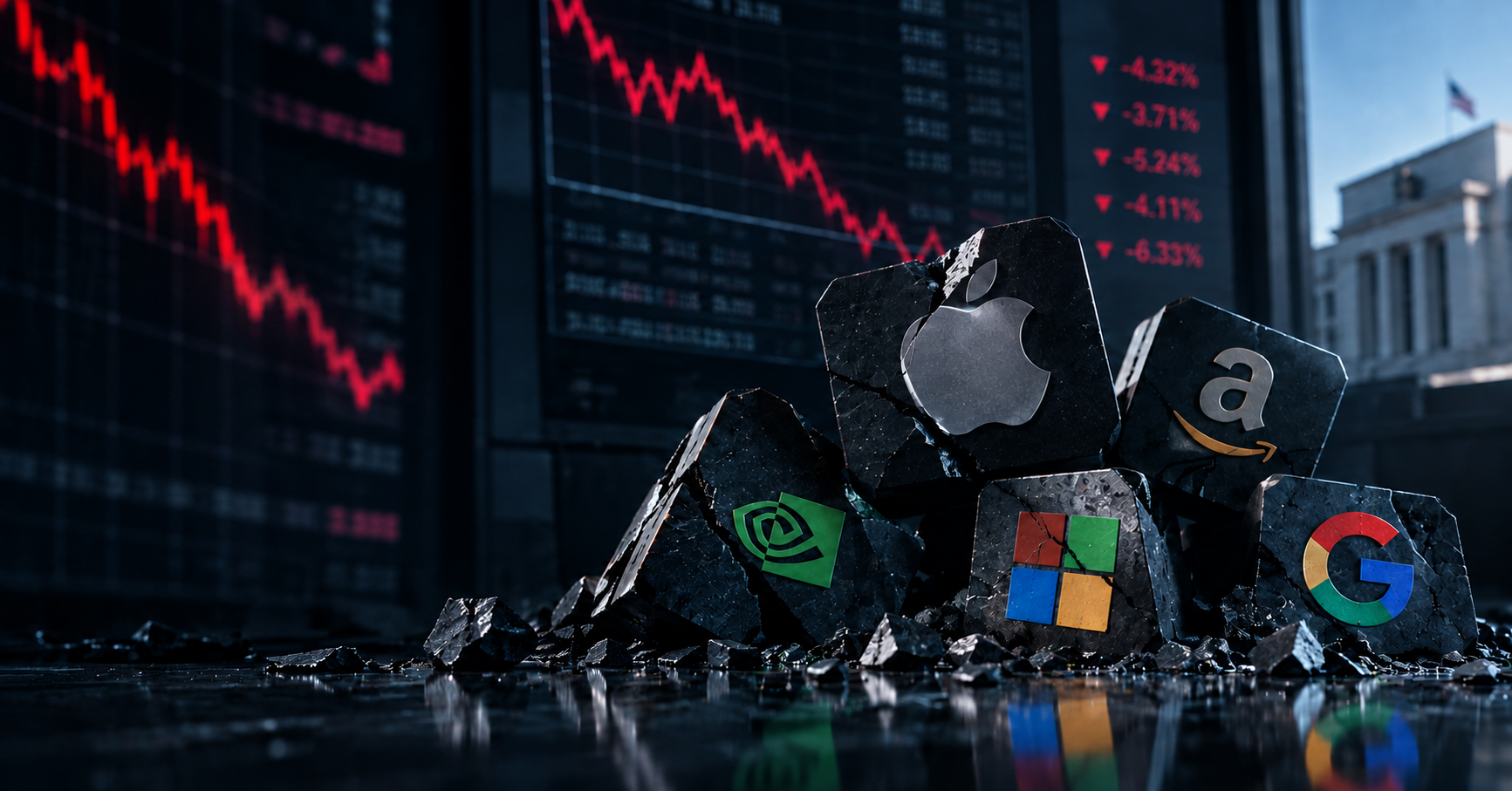
While the market celebrates the artificial intelligence revolution and walks on the mirage of infinite growth, a collective blindness seems to have afflicted Wall Street. In fact, investors seem to have forgotten the inexorable law of financial gravity: “whatever goes up must come down.
If the Federal Reserve (Fed) raises interest rates again to contain inflationary pressures or recalibrate an overheated economy, the impact on the large technology firms will not be a simple pothole in the road, but a structural collapse.
Without free money, financial mathematics has no mercy for the fashionable companies.
The trap of "long duration"
The valuation of any company is not based on promises of dominating the world in 2040, but on the cold mechanics of the Discounted Cash Flow. According to this principle, the present value of a company is the sum of the cash flows it will generate in the future, discounted by a rate that reflects the risk and the cost of money over time.
Given this understanding, when the Fed raises its benchmark interest rates, the cost of capital increases and the value of companies will decline.
In the case of technology companies, what happens (and to an excessive degree) is that the cost of their capital will rise and the price of their shares will be lower. Moreover, nearly all of them are heavily indebted to develop new infrastructure, which aggravates the situation further. More expensive debt and a higher discount rate equal lower financial value.
The foregoing particularly affects the so-called "long-duration growth stocks" (long-duration growth stocks), such as the giants Tesla and Nvidia, whose monumental current prices are not justified by the earnings they generate today, but by profits projected into a fantastic future of robots and humanoids with brain implants.
The Fed's victims
Not all technology companies will suffer the same degree of damage from a Fed rate hike, since mature companies with immense existing cash flows can absorb the impact of such a measure. The real damage may well be suffered by stocks that today trade under “messianic expectations.”
One of the most evident victims of Fed decisions could well be Palantir Technologies (PLTR), the well-known big data and artificial intelligence company. While Palantir has a real competitive niche in the analysis of government and commercial data, and has posted year-on-year growth exceeding 56%, the stock has at times traded at completely irrational multiples, exceeding 216 times its earnings (P/E – Price-to-Earnings) and trading at more than 78 times its revenues. Palantir is the epitome of a "long duration" stock, because its astronomical market capitalization assumes years of uninterrupted hypergrowth with no margin for error going forward.
Similarly, Snowflake (SNOW), one of the major cloud data storage and analytics companies, structurally depends on an accelerated-growth business model that bets on the future and is far removed from its current reality.
When we mention PLTR and SNOW as examples, we do not exclude other well-known technology names such as Tesla, Nvidia, Alphabet, AMD, Broadcom and Intel, since nearly all of them carry speculative overvaluation based on their future development plans.
The end of the “asset-light” era
The vulnerability of technology companies becomes even more acute when we analyze a macroeconomic transformation seen in the United States over the past decade. The software sector thrived in the “asset-light” era, since growth required very little physical investment and margins were massive, a perfect model when interest rates were nearly zero and inflation was contained.
However, the AI revolution has drastically changed the rules of the game in the technology world. To sustain advanced software from firms such as Palantir or Snowflake, the industry needs data centers, high-performance servers, semiconductors and staggering electricity consumption.
Goldman Sachs estimates that global capital expenditure (Capex) related to AI will exceed $1 trillion ($1.019 trillion) by 2026. Therefore, technology companies are taking on historic levels of debt to finance this tangible physical infrastructure.
This is where the fatal blow of Fed rate hikes lies, since, on the one hand, the future cash flows of companies are instantly devalued, and, on the other, the debt needed to finance the massive physical infrastructure on which they depend to exist becomes lethally more expensive.
Based on these principles, the market will shift from rewarding “promises and illusions of infinite-margin software” to seeking refuge in heavy infrastructure companies that generate real returns today.
The unavoidable reality
As investors, we must understand that financial physics is unavoidable. Grandiloquent narratives and press releases full of the phrase "Artificial Intelligence" may hypnotize markets and sustain prices temporarily, but in the long run, the cost of capital is always a fundamental element in estimating company valuations and share prices.
If the Federal Reserve decides the economy needs an incremental rate adjustment, the “brightest stars in the high-growth technology firmament” will suffer a painful and severe correction. This will not necessarily happen because their products stop working or their businesses fail, but because the mathematics underpinning their current valuations is incompatible with a world where money has a price again. Whoever chooses to ignore the discount rate and the cost of debt will end up paying the most expensive bill of the decade.
For our peace of mind, for now it seems the Fed will not raise interest rates, but the mere fact of not cutting them could result in a soft-landing for the technology market.