Articles
The empty house and the smell of arepa: saudade, memory and politics in Venezuela
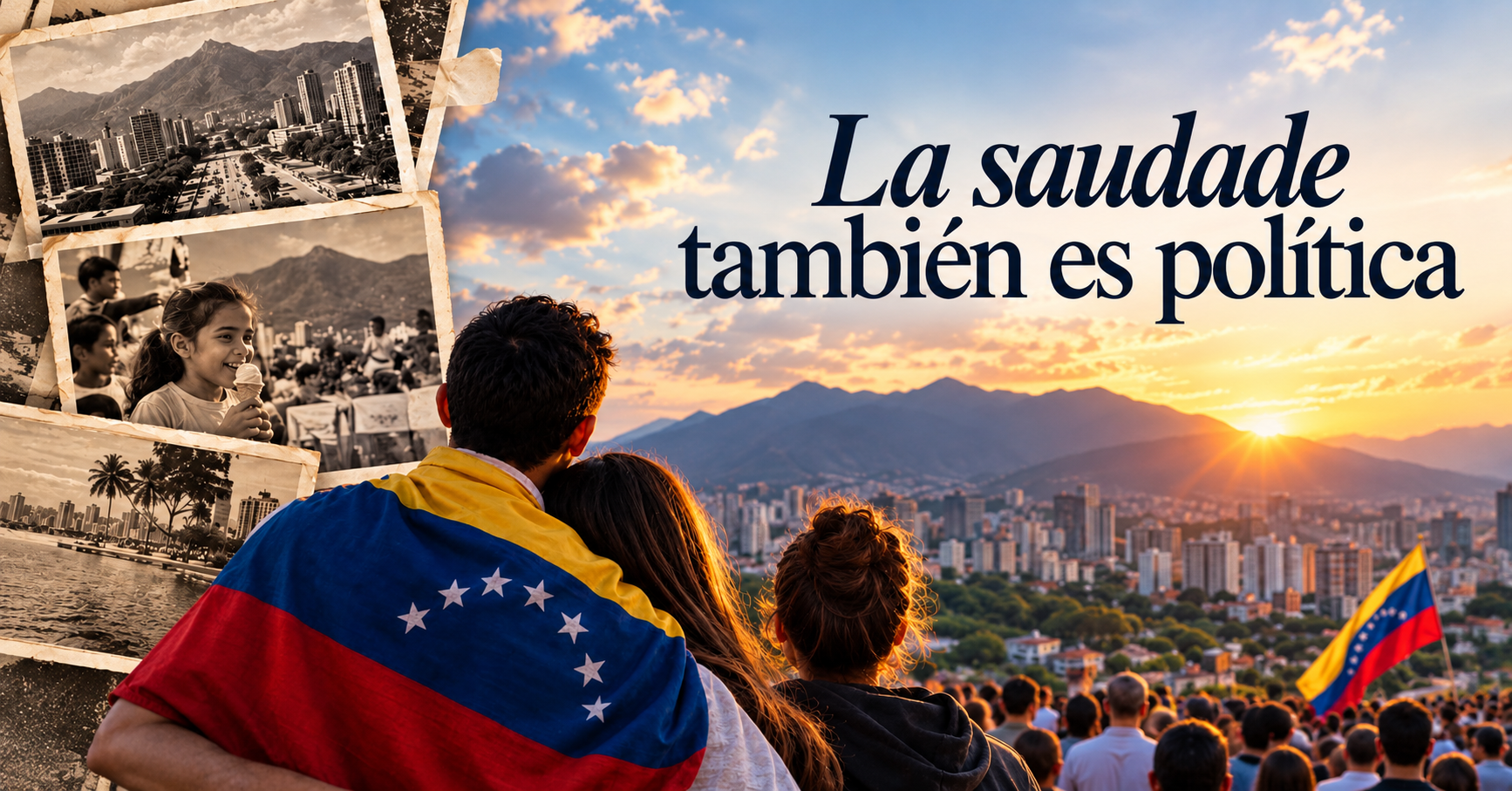
In thousands of Venezuelan homes there is a room that has stayed exactly the same. The bed is made, a poster hangs on the wall, and the clothes that did not fit in the suitcase are still there. Parents walk past that door every day and feel something hard to explain: the room is still there, but the life that filled it left for Bogotá, Madrid or Santiago. That heavy emptiness has a name: kenopsia, the unease produced by places that used to be full of people.
Meanwhile, on the other side of the map, someone walks past a bakery, smells a freshly baked cachito or hears a gaita in December and is suddenly back on the corner of their house or in their housing development. They did not go looking for it; the memory found them. This is the Proustian moment, named after Marcel Proust's famous madeleine. Venezuela now lives between these two experiences: the empty house inside and the memory that ambushes from outside. And between the two, a feeling the Portuguese call “saudade” has grown.
A country with its heart in two places
Saudade is more than sadness. It is longing for a well-being that once existed and no longer does. In Venezuela it has stopped being an individual feeling and become a collective mood, fed by hyperinflation, a humanitarian crisis and an exodus of more than seven million people. Few countries have seen so many people leave in so little time, and that leaves a mark on the way we remember and feel.
What the brain does with the past
Psychology has an explanation for why the past almost always seems better. It is called retrospective positivity: over time, our memory softens the bad and highlights the good. We remember the trip to Morrocoy, but not so much the line, the heat or the inequality that already existed. Memory is not a faithful archive; it is an editor working in our favor.
This is not negative in itself. Research on nostalgia shows that, in moments of uncertainty or loneliness, recalling happier times gives us meaning, connects us with others and reminds us who we are. For a battered people, nostalgia works like an embrace. The problem begins when someone discovers that the embrace can also be used as a tool.
When nostalgia takes the stage
Mass political communication has known this for a long time: people do not decide on data alone, they decide on emotion. A campaign does not sell an economic program; it sells a sensation. And in Venezuela, no sensation moves people as much as that of the country we once were.
From the opposition, the narrative of “the Venezuela of before” evokes a prosperous country that welcomed immigrants and where a salary was enough to live and travel. The promise is rarely a new future, but a return home. From the governing party, nostalgia points elsewhere: to the founding myth of Hugo Chávez and to the boom of the first years of this century. Mass concerts and consumer bubbles revive memories of the “good times” and offer a sense of normality.
Two sides are fighting over the same thing: ownership of the memory. Social media adds to this. A photo of Caracas in the 1970s or a video of a packed bodegón is shared thousands of times, because algorithms love what moves us. Nostalgia has become viral content, and viral content has become political message.
The risk of living with eyes on the rearview mirror
The essayist Svetlana Boym distinguished two kinds of nostalgia. The restorative kind wants to rebuild the past as it was, and to do so it idealizes it. The reflective kind accepts that the past does not return and uses it to understand the present. The first is the one most used on the stage, and it is the most dangerous.
Why? Because no country can copy its past. Because idealizing 20th-century democracy or the oil boom hides the mistakes that brought us here. And because a feeling cannot be audited: one can promise the return of an era without ever explaining how. A deeply sad people is also an easy people to move, and moving people is not the same as persuading them.
Toward a nostalgia that builds
None of this means we should stop missing things. Saudade is, at heart, a cord that keeps our identity together amid the shipwreck. As long as we remember that we once lived better, we will know it is possible and will have something to demand.
The key is to change the question. Instead of “when do we become what we were again?”, we should ask “what from that is worth keeping, and how do we do it differently?” The kenopsia of that empty room does not ask us to paint it the way it was before. It asks us to fill it with life again.
May we keep the arepa, the gaita and the Ávila. But the next time a politician talks to us about the past, let us do the healthiest thing a nostalgic people can do: ask them about the future.