Articles
Venezuela's dollarization is debated in Washington and punished in Caracas
In eleven days in August, the National Assembly denied having hired Steve Hanke, removed the lawmaker who proposed dollarization and, nine days later, that same plan turned up at the White House.
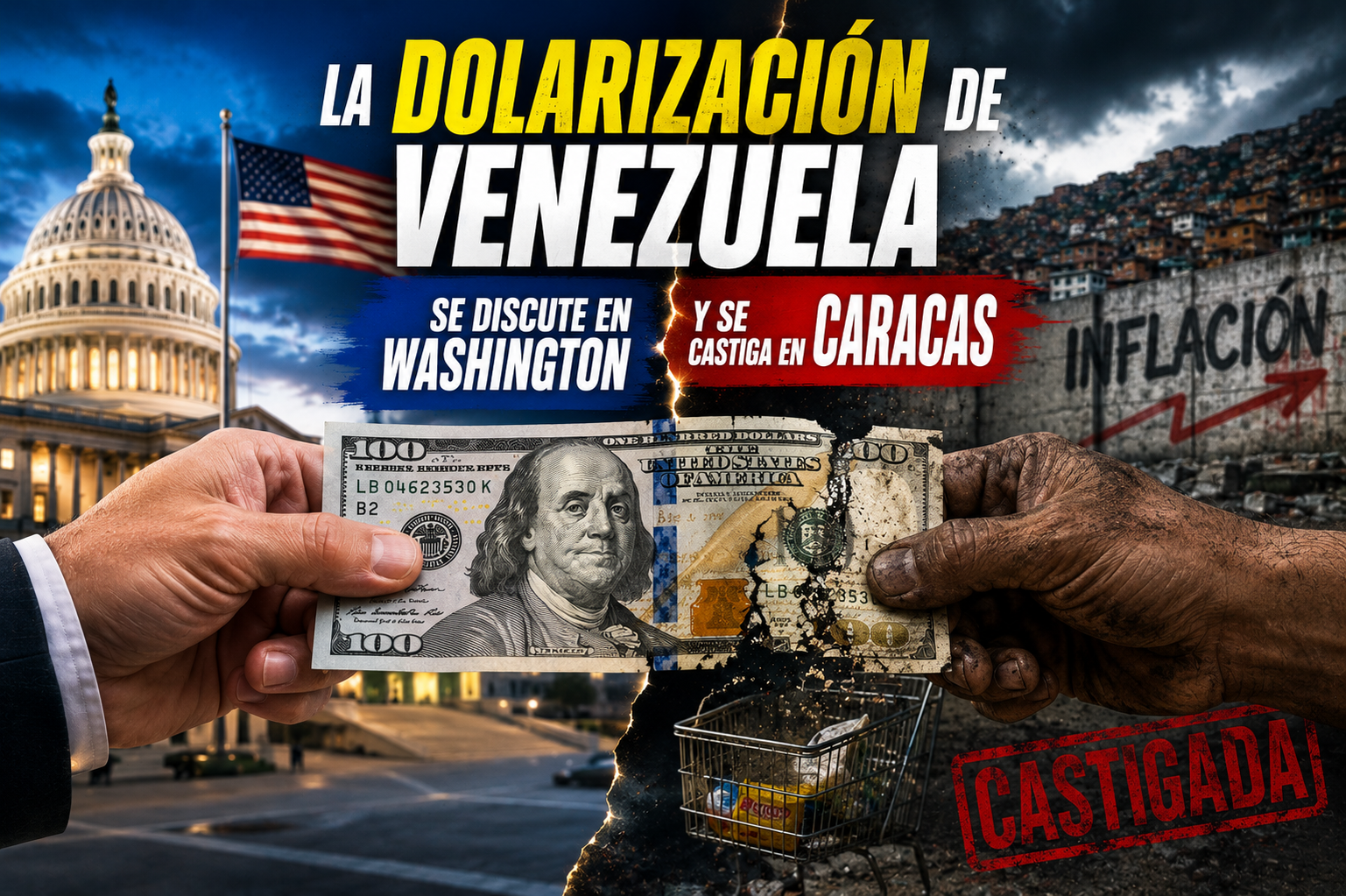
In eleven days in August, three things happened that, taken separately, look like minor episodes of Venezuelan politics. Together they tell a different story: an economic debate that the country is not allowed to have in its own National Assembly, and that is instead taking place, meanwhile, in an office in Washington.
On August 21, Efecto Cocuyo reported that the National Assembly had hired the American economist Steve Hanke, a professor at Johns Hopkins University, as an adviser to implement dollarization schemes. That same day, Assembly president Jorge Rodríguez denied it to Últimas Noticias with a remark worth reading in full: "The news is so outlandish, so absurd, so childish and so silly, since management of the monetary unit and macroeconomic processes falls to the National Executive and the Central Bank of the Bolivarian Republic of Venezuela, that I decided not to pay it much attention." Rodríguez added that hyperinflation had already been defeated and ordered an investigation into the origin of the report.
On August 22, according to Bitácora Económica, the same Assembly removed lawmaker Antonio Ecarri as head of the Venezuela-United States parliamentary friendship group. The reason was precisely that proposal: Rodríguez accused him of violating article 133 of the Internal and Debate Regulations and article 318 of the Constitution, which establishes the bolívar as the country's monetary unit. Ecarri responded that a deputy has legislative initiative, confirmed that he works with Hanke, and struck back with a figure: "More than $6 billion has been burned through currency exchange desks without solving the underlying problem." He added that his critics offered no proposal to close the exchange-rate gap.
On August 31, Hanke told La Patilla that his project to officially dollarize Venezuela is already at the White House, delivered at the direct request of the administration of Donald Trump. The plan was drafted together with Ecarri, the same lawmaker removed nine days earlier for proposing it. Hanke puts the probability that Venezuela officially adopts the dollar at between 50% and 80%, and said that such a decision should have the backing of citizens. He also acknowledged that he advises the so-called Great Dollar Strategy of that administration, which aims to expand the international use of the US currency.
What the law says and what happens on the street
Article 318 exists and is unambiguous: the bolívar is the monetary unit of the Republic. On paper, that is the reason formal dollarization cannot be approved without amending the Constitution. In practice, anyone who has bought something in Caracas knows that a large part of commerce already prices and charges in foreign currency.
That gap between the rule and the street is the real issue, and it is not resolved by removing anyone. An economy can be dollarized de facto without being so de jure, and that has concrete consequences. The main one is that the country gives up deciding on its currency while still suffering the consequences of not having one: those who are paid in foreign currency protect themselves, while those paid in bolívares, such as civil servants, teachers and pensioners, absorb every movement in the exchange rate through their wages.
This matters more to the country than it seems
Here is what worries us. A decision of this size, giving up one's own currency, is among the largest a country can make. It affects savings, wages and the capacity to respond to a crisis. It deserves public debate, with data on the table and with those who will live with its consequences.
What these three weeks show is the opposite. Inside Venezuela, the debate was closed through disciplinary action: the person who raised it lost his post. Outside, it advances in the form of a document delivered to a foreign government that also has a declared interest in more countries using its currency. There is no need to share the Ecarri and Hanke proposal to see the problem: when discussion is prohibited at home, it does not disappear, it moves.
There is an asymmetry worth naming. The Great Dollar Strategy is, by definition, a policy of US interest. That a monetary plan for Venezuela is being drafted within that framework does not invalidate it, but it obliges us to ask whom it benefits first and with what counterparts. No foreign economist, however good, and no government other than Venezuela's can answer that question.
We neither defend nor rule out dollarization. We defend that it be decided where it should be decided and by those who should decide it. Insisting that the bolívar is the only currency while people buy in dollars does not protect monetary sovereignty: it leaves it undiscussed. And closing the debate by regulation does not prevent dollarization; it only ensures that it arrives, if it does, without anyone having been able to weigh in.