Articles
María Corina, come back now!
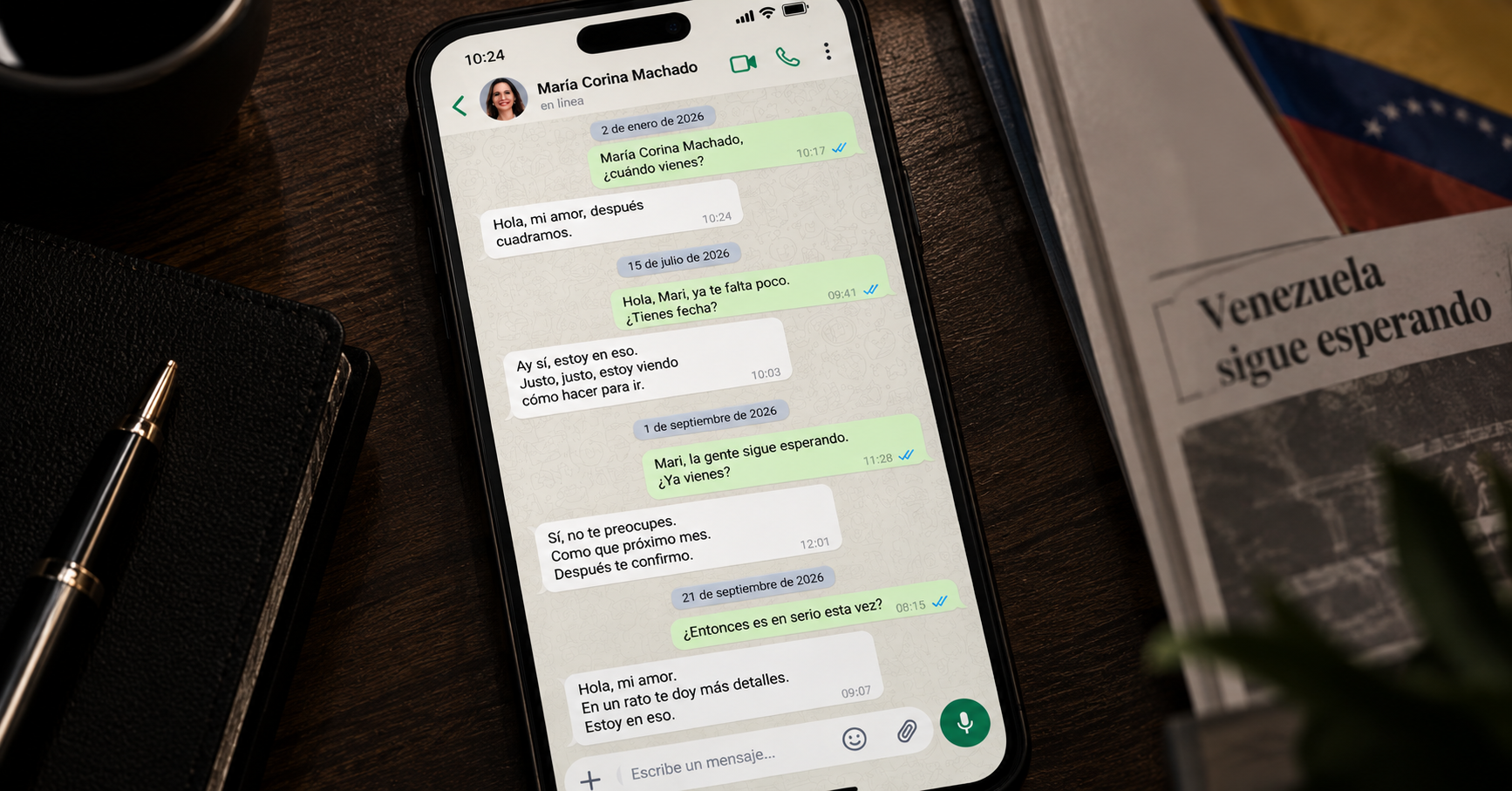
The return of María Corina has become the anthem of those who still hope that the undisputed opposition leader will keep steering their destiny.
The now-famous intention to return by María Corina has been heard since Nicolás Maduro's exit, after the earthquakes, in various interviews, in messages and in solemn statements.
In April, Machado told Reuters she expected to be back before the end of 2026. By June, after the earthquakes, she said “the moment had come” and that she would be “very soon” with Venezuelans, and that she would even console, “live,” the mother of one of the fatalities of the quakes. Moreover, various media outlets say María Corina has tried unsuccessfully to enter the country in recent days, though this has yet to be confirmed.
Let us hope the return of María Corina is not a matter of the notoriously loose Venezuelan sense of time, under which “ya voy” (“I'm coming”), “ahoritica llego” (“I'm arriving right now”), “saliendo pa' allá” (“heading over there”), “llegando” (“arriving”) and so many other statements about arrival times can mean anything from minutes to days, weeks, months, years, or never.
Beyond Venezuelan vocabulary and semantics, Trump appears as an obstacle in the equation of María Corina's return. Here one should acknowledge an extraordinary irony: for a long time Machado built a very close political relationship with Trump, but now that she wants to return, the relationship seems to have taken on that wonderful format of international political diplomacy:
“We support you, dear and remarkable Nobel laureate María Corina, but let us see whether it is advisable for you to be in Venezuela,” Trump himself would say.
In this regard, Reuters reported in September that U.S. officials have shown reluctance about Machado's return and that, according to opposition sources, she still plans to return, but without a fully clear date. In other words, María Corina wants to return, her supporters expect her to return, but the American government is not convinced that her return to Venezuela is a good idea.
But let us not commit the injustice of saying that Trump forbade her to return. According to the EFE news agency, Trump expressly denied this in July, saying he had not asked her to stop traveling and even recalling the good relationship he maintained with Machado. Moreover, a State Department official told Congress that the United States would not obstruct her return and that Machado, as a Venezuelan citizen, had the right to return.
One imagines Machado in Panama typing on her phone: “Already?”, “Now?”. “And now?”, “And when?”. Meanwhile, Washington replies: “Not yet,” “Wait a moment,” “We are coordinating,” “Soon.”
“Coming soon,” “we'll see,” “soon,” “we are analyzing,” are expressions used when a politician does not want to say “I don't know.”
In that sense, Machado has used them with a perseverance worthy of study.
Reuters reported that the talks backed by the United States to reorganize Venezuela's political system do not include Machado in the formula. And on September 18 the same agency reported that Trump planned to meet Delcy Rodríguez at the UN meeting in New York, amid a growing relationship between Washington and the Venezuelan interim government.
For now, what we laymen see in political matters is that Trump keeps moving closer to Delcy Rodríguez, Machado keeps waiting for the moment to return, and the Venezuelan calendar keeps turning its pages.
In the current Venezuelan political moment, the real act of opposition leadership would be to see María Corina step down the airplane's stairway, or get into a launch, whether by land or in a carrucha, or however she likes.