Articles
What do a missile and a washing machine have in common?
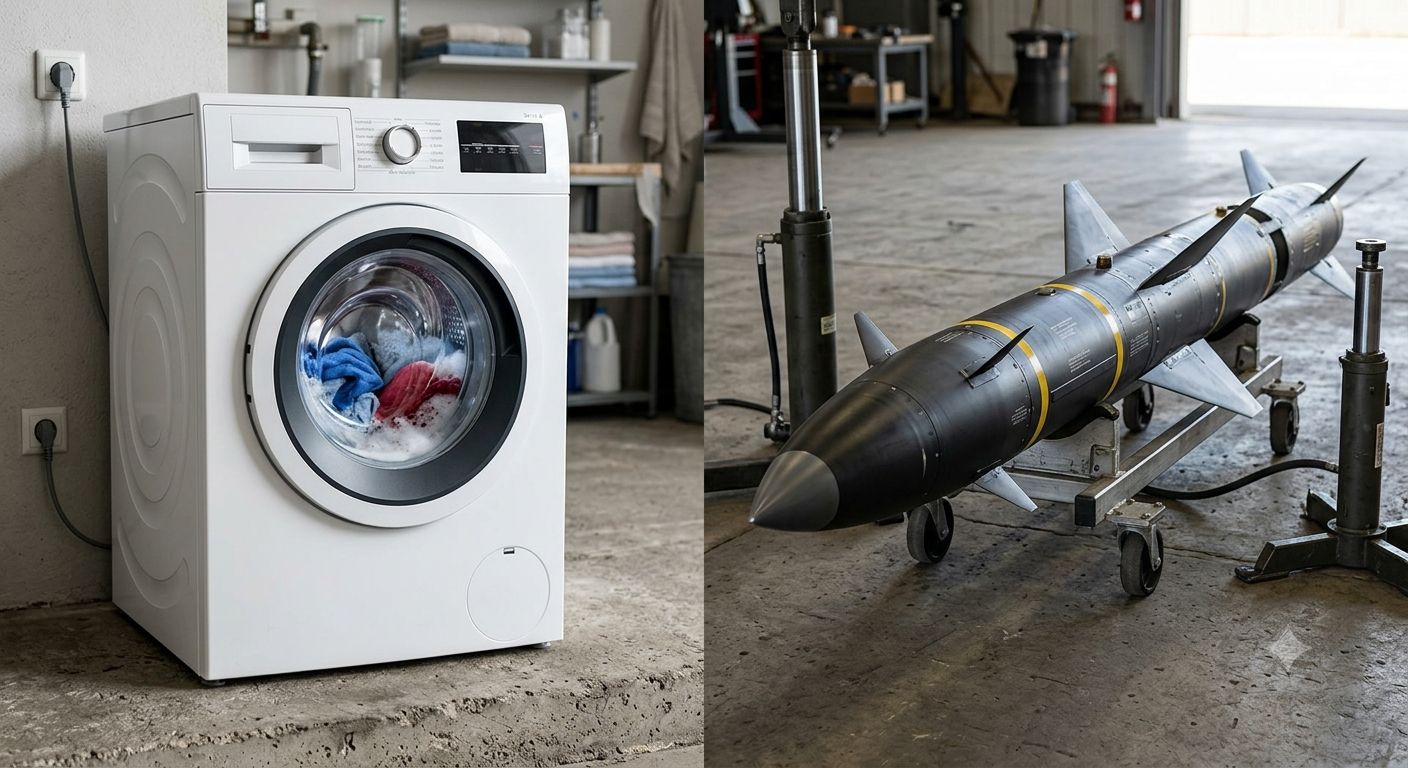
What do a missile and a washing machine have in common?
SurEconomics staff, July 2026
Almost nothing, except that neither can be manufactured without chips…, although they do not use the same type of chip, since a washing machine is assembled with an old, large and cheap chip, while a missile is not. Nevertheless, both chips come from the same industry, and that industry today carries significant geopolitical risks.
Scarce chips
In 2021 the world ran short of chips. The causes were not the pandemic, wars, blockades or the world's trade disputes; simply, the chips produced at the time were not enough to meet the growing demand of the digital industry. For that reason, the U.S. and China lost some $500 billion across different industries that require microprocessors.
More than 90% of the planet's advanced chips (nano and microchips) are made in Taiwan, an Asian island that China considers part of its territory and over which the Americans maintain a clear strategic interest. Almost all chips are made by a single company, TSMC, a huge consortium that manages the entire production value chain of microprocessors. The second producer, Samsung (South Korea), does not generate even a tenth of the Taiwanese giant's output.
How much are chip companies worth?
Although TSMC is the world's largest chip producer, with a market capitalization of $2.08 trillion, other companies in the sector, such as the U.S. company NVIDIA, are valued at more than twice TSMC's, at some $4.7 trillion (almost the equivalent of Germany's GDP), and this without owning a single factory. The same can be said of AMD, which also has no direct chip production and has a current estimated value, based on its market capitalization, close to $1 trillion.
The new oil and the geoeconomic fragility of chips
It is said that chips are the oil of this century, which is not entirely true, since oil is distributed across many countries and can be replaced by other energy sources. By contrast, chip production is concentrated in Taiwan and has no substitute.
NVIDIA and AMD are U.S. giants that develop technology and know-how for manufacturing advanced chips, which are then mostly produced in Asia. The most basic chips, those used in washing machines, can be made in several parts of the world, including the U.S. and China; but the most complex, small, high-technology chips, those used in artificial intelligence (and missiles), concentrate their production in Taiwan, as we mentioned earlier.
Hence the frequent disputes and military threats between the U.S. and China over control of Taiwan. Hence also the fact that China and the U.S., seeking to gain hold of the world's technology (and economy), as well as for national security reasons, now compete for the scarce output of Taiwanese chips. Both powers have also embarked on a race to manufacture advanced microprocessors in their own territories, which cannot be achieved until after 2030.
Sources
· Deloitte
· TrendForce
· Semiconductor Industry Association
· Gartner
· CNBC
· CSIS
· U.S. Department of Commerce
· Mordor Intelligence
· Visual Capitalist
· Xataka
· La Jornada