Articles
Silo: Plato's last cave, on Apple TV
Science fiction, politics, social psychology and dystopia in Silo , Apple TV's series: a contemporary analysis of authoritarian political systems.
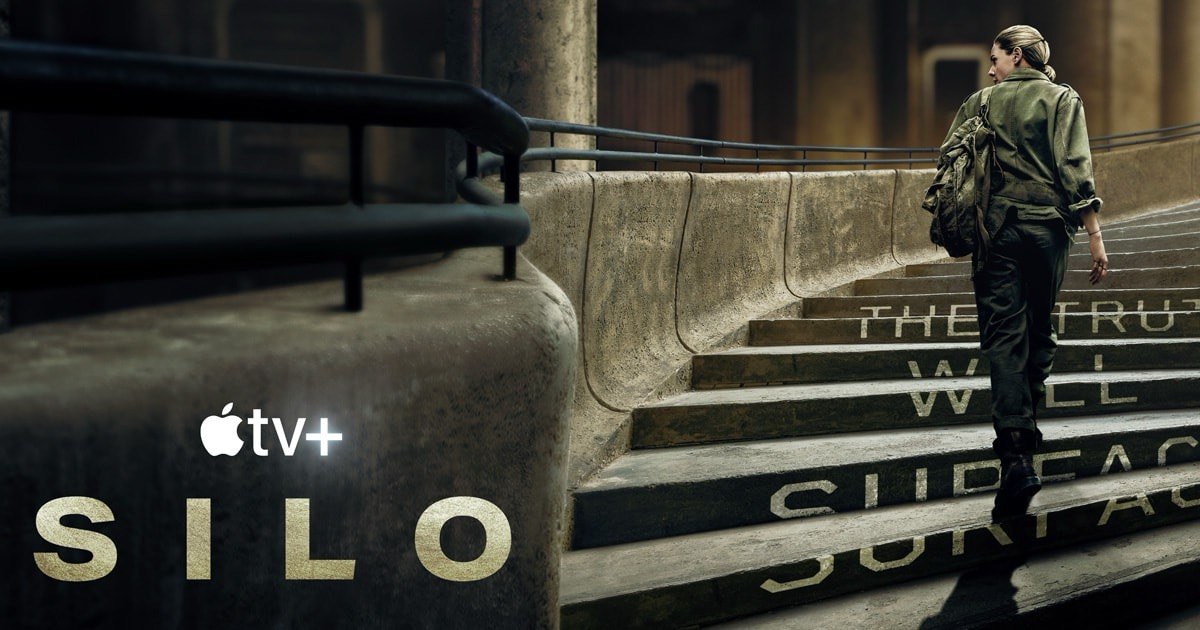
What happens when an entire society accepts as truth something it has never been able to verify? That is probably the most powerful philosophical question posed by Silo, the Apple TV science fiction series based on Hugh Howey's trilogy. The premise is simple and, precisely for that reason, unsettling. Some 10,000 people live underground in a gigantic vertical structure, because the outside is supposed to be toxic and deadly. Nobody knows exactly why the silos were built, who made the decision, or what actually happened to the outside world. Those who investigate too much become a threat to the system, but Silo is not really a story about people who live underground; it is a story about people who live inside an idea.
The political and philosophical dimension of this series brings to mind Plato's allegory of the Cave, in which reality depends on what we are able to see. A group of people remains chained inside a cave from birth. They cannot turn around and see only shadows projected onto a wall. For them, those shadows constitute reality. If one of them manages to free himself and leave the cave, the light is initially unbearable. He then discovers that what he considered real was only a partial representation of reality, and here the parallel with Silo is powerful for those of us who enjoy politics within science fiction.
The inhabitants of the silo have one representation of the outside world: a screen. That screen shows them a devastated, gray and deadly landscape. The image works as evidence, and they have no need to go outside because everyone has learned that going out means dying. This may recall other works such as "The Village" or "Maze Runner". In Silo, the cave is not simply a place of ignorance; it is a system organized to produce a specific perception of reality, and that makes the series a politically uncomfortable reflection for those of us who live within a system with authoritarian features.
Hugh Howey, the series' creator, explained that one of the original ideas behind the story was precisely a society whose information about the outside arrived through a single screen, and that this filtered information ended up affecting its inhabitants psychologically. The screen, therefore, is not merely a window; it is a political institution in which power does not need to hide the whole truth, only to control access to it. Will North Korea turn out to be a country inside a silo? We shall see.
One of the most interesting aspects of the series is that power does not work exclusively through violence. In fact, there is almost none in the scenes; armed confrontation is not common in the series. The inhabitants do not know their history, there are forbidden books, and there are memories that must be erased. There are questions that must not be asked, and the past becomes a politically dangerous territory. Is it in the interest of authoritarian systems to erase the past or to distort it? Let us reflect on this.
Whoever controls information has a tremendous capacity to control the interpretation of reality. The silo's government does not need to be constantly repressing 10,000 people; it is far more efficient to get those 10,000 people to internalize the rules, adapt their behavior to the system by suppressing their emotions, and censor themselves. Here appears one of the series' great insights: the most efficient power is not necessarily the one that compels, and in everyday life this is quite a big fact. Power is not the same as authority.
The prohibition on leaving the outside is especially important because it is backed by an absolute threat: death lies outside, and fear thus performs a political and psychological function. A population that believes it is permanently threatened is much more willing to accept extraordinary restrictions. However, this does not mean that every security policy is necessarily authoritarian. The more interesting question Silo raises is another: How much freedom are we willing to sacrifice when we believe our survival is at stake? We are back to the political theory classes at university.
This question works as a social experiment: if the alternative presented to citizens is freedom as a synonym for death and obedience as a synonym for survival, most would probably choose obedience. But a rather uncomfortable question remains in the middle: who decides that these are really the only alternatives? What kind of social contract is that?
We can also interpret Silo through Hobbes. In the Leviathan, Thomas Hobbes starts from a fundamental concern: fear of chaos and violence can lead individuals to accept a strong sovereign power in exchange for security, and in Silo an extreme version of that contract is represented. Citizens accept enormous restrictions because the system provides them with something they consider more important: security.
There is something truly disturbing in the series: the population cannot freely know its past and cannot investigate certain matters, but it has food, housing, work, energy and protection. The political question the series poses is therefore: how much freedom can a society sacrifice to guarantee its survival? Which political model does this recall? We will leave that hanging, so that readers can reflect on whether this is something we have seen in Latin America. But let us ask another question: at what point does security stop protecting society and begin protecting the power system itself? Yes, security protecting power itself; Orwell looks small next to this proposition.
When we analyze the psychology of an enclosed society, we discover that the silo controls not only bodies but also behavior, expectations and emotions. A society that lives for generations believing the outside is deadly develops a collective psychology based on fear and the restriction of its emotions. This generates several psychological mechanisms, such as conformity: when everyone around believes the same thing, questioning it carries an enormous psychological cost. In this sense, the individual thinks: "If 10,000 people believe this, the mistaken one is probably me." It is one of the most powerful mechanisms in social psychology. We also observe cognitive dissonance, which occurs when evidence contradicts a fundamental belief and psychological tension arises. Accepting the new information means admitting that many things we have believed our whole lives might be false, which is why many people prefer to reinterpret the evidence rather than change their system of beliefs.
In political terms, societies do not always defend an idea because it is true; sometimes they defend it because they have built their identity around it. Another aspect to analyze is obedience to authority and the tendency to obey institutional structures. That is why authority in this series is not presented as a tyrant but as a shabby sheriff, a mayor who never shouts, a judge whose face is never seen, and faceless officials whose procedures and rules are applied without much fuss. At this stage the system acquires legitimacy because it appears institutional, or at least that is how the population perceives it. Here is another question left hanging for reflection: do we obey because we believe an authority is right, or because we believe it has the right to command?
In the series, memory is used as a political instrument. One of the most interesting elements of Silo is the relationship between memory and power. A society that does not remember its past has difficulty questioning its present. If you erase a community's memory, you can also erase its capacity to compare and to see beyond its own biases and mental limits, and without comparison it is far harder to detect that something has changed. This recalls George Orwell's famous idea that controlling the past allows one to control the present, but in the case of Silo, the series introduces an additional psychological dimension: forgetting can also be a form of protection.
The series' director, Hugh Howey, has explained that the theme of forgetting and of the mechanisms designed to erase traumatic memories was central to the story, and that the idea of a society unable to escape the weight of its past runs through the saga. That is why memory in Silo is not only historical; it is political, psychological and existential.
As for the character Juliette Nichols, I will only say that she is a narrative representation of the process by which a citizen moves from obedience to political awareness, and this does not necessarily label her a revolutionary or an agitator. She is one more person within the system who began by questioning something and insisted on evidence.
An uninformed population can be governed; a population that starts asking questions can become a problem. That is why Silo's most dangerous question is not: who governs? Rather: why? Why can we not leave? Why does nobody remember? Why does this rule exist?
All of this leads to a great dilemma: what if the lie protects society? What happens if the truth can destroy the social order? Suppose that revealing certain information provokes a rebellion, the rebellion provokes chaos, and the chaos causes thousands of deaths. Is it morally justifiable to hide the truth to prevent this? The dilemma recalls one of the oldest questions in political philosophy: can there be a politically necessary lie?
Plato, in fact, was no naive defender of absolute transparency. In The Republic he introduces the idea of the "noble lie": certain fictions may be used to maintain the order of the city, and Silo takes that idea into a dystopian setting. At this point we ask again: do people have the right to know the truth? Can a society survive certain truths? For reflection, once more.
One of the series' most important moments occurs when knowledge stops being individual and begins to become collective knowledge. While Juliette alone knows something the others do not, the system can isolate her. But when doubt begins to spread, something different appears: mass psychology. Fear can be contagious, but so can hope. Obedience can be contagious, but so can rebellion. This connects directly with Gustave Le Bon, Elias Canetti and other authors who studied collective behavior under the following premise: crowds can develop dynamics different from those each individual would have on his own.
A person may be afraid to rebel, but thousands of people who simultaneously discover they share the same fear may begin to act differently. Here power faces a problem: the individual can be controlled, but collective consciousness is much harder to control.
In Silo we can see a metaphor for the state in which the architecture itself has a political function. The silo is vertical; it has levels, departments, hierarchies, producers, administrators, governors and watchmen. The physical structure reproduces the social structure, and space becomes a representation of power. We are not facing a horizontal society; we are literally facing a society built in tiers.
Hugh Howey has explained that the concept of Silo also grew out of his interest in so-called information silos: communities that are informationally isolated, receive specific versions of reality and stop checking them against other perspectives. That makes the series particularly relevant in the era of social media.
Today we do not necessarily live locked underground, but we can be enclosed within an algorithm, an ideology, a digital community, an information bubble, a political party, a conspiracy theory or a social group, and each of us can build our own "screen."
As a final point of analysis, we can speak of the paradox of freedom. In the series, the system not only deprives its inhabitants of freedom; it also provides them with an explanation for why they should not want to be free, and that is far more powerful. A system that convinces the citizen that his own freedom is dangerous can be much more stable. That is why Silo should not be interpreted solely as a critique of authoritarianism, and those of us who have lived under it can recognize exactly every detail of this superstructure.
The greatness of Silo lies precisely in its use of science fiction to address problems that are not futuristic: power, fear, propaganda, memory, obedience, self-censorship, information, collective psychology, leadership and freedom. But there is one question I would not like to let pass: who has the power to define what is true? What lies truly outside our screens?