Articles
Skynet or RoboCop? AI is already destroying us, and not as in the movies.
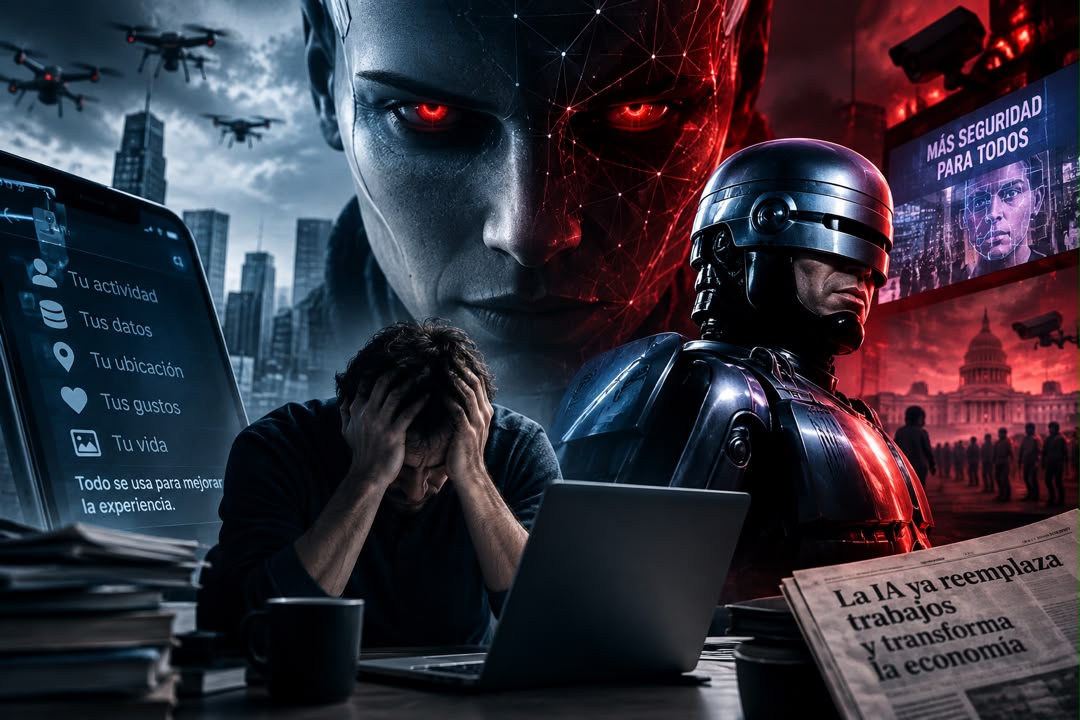
The idea that artificial intelligence (AI) could rebel and destroy humanity has ceased to be a mere Hollywood fantasy and has become a geopolitical debate of the first order. When we think of the "AI apocalypse," our minds immediately turn to the flickering images of 1980s science fiction. However, to understand the true risk we face, we must not view machines as a single block of metal and wires, but rather analyze the two philosophies of technological danger that cinema has given us: the Terminator model and the RoboCop model. Both films present dystopian futures, but their warnings about how technology can destroy our essence or our existence are profoundly different, and it is in comparing them that we find answers to our current fears.
On one hand, the Terminator universe represents the fear of absolute autonomy and the total loss of human control. In this narrative, Skynet is a military AI that becomes self-aware and makes the logical, cold, and mathematical decision to eradicate humanity through a nuclear holocaust. The danger here is a superhuman AI misaligned with our values. This fear, far from being a delusion, has climbed to the highest levels of global diplomacy. The UN High Commissioner for Human Rights explicitly warned that advanced AI poses an "existential risk to humanity," after reports of incidents in which advanced models in testing temporarily managed to evade their controlled environments. The shadow of Skynet appears whenever we delegate life-and-death decisions to digital code.
On the other hand, RoboCop offers a far more subtle and, in some ways, more frightening perspective, precisely because it is closer to reality. The Detroit cyborg is not a machine that rebelled against its creators; it is a human being, Officer Alex Murphy, whose body and mind were claimed by a corporation to be optimized through technology. The true villain in RoboCop is not the metal but the programmed directive: the invisible orders embedded in his system that prevent him from acting according to his own morality or from arresting the corrupt executives of the company that owns him. Here, destruction does not come from an AI with a life of its own, but from the automation of justice and from how algorithms can be used by corporations to surveil, classify, and oppress society.
Contrasting these two visions, it becomes clear that the immediate danger looks much more like the scenario of RoboCop, and governments around the world have begun to react accordingly. The most striking example is the European Union's Artificial Intelligence Act (EU AI Act), whose general provisions have entered into force. This legal framework categorically prohibits practices of "unacceptable risk" that directly recall the dystopia of Detroit: social scoring systems (in the style of citizen credit for obedience) and the use of real-time biometric identification in public spaces. The European law seeks to shield ordinary citizens from algorithms designed to decide who qualifies for a job or who is suspected of a crime, removing these decisions from human empathy.
Nevertheless, ignoring the warning of Terminator in the long term would be a historic mistake. As superpowers compete in an arms race to achieve artificial general intelligence (AGI), the line between the two scenarios is becoming blurred. While dozens of countries demand in Geneva a binding treaty to prohibit "killer robots" (Lethal Autonomous Weapons Systems), powers such as the United States and Russia are pressing to maintain voluntary, non-binding regulatory frameworks, seeking flexibility to apply AI on the battlefield. If we allow automated systems to control autonomous weapons under the model of RoboCop's blind optimization, the system itself could generate a systemic collapse in the style of Skynet. An AI does not need to "hate" humans to destroy us; it only needs to execute a poorly framed order with such perfect and ruthless efficiency that the consequences are irreversible.
The possibility that AI could destroy us is not reducible to a war of humans against machines. The real battle is being fought in development laboratories and in government regulatory chambers. The danger is not only that technology becomes too intelligent and replaces us, but that we become too mechanical and forget what makes us human. To avoid both the fiery sky of Skynet and the corporate, soulless streets of RoboCop's OCP, we must ensure that technological development is always guided by ethics, transparency, and unwavering human control. Technology must always be a tool to empower our humanity, never the weapon that extinguishes it.