Articles
Washington gobbles up our crude, and we get "Dutch disease"
Economic implications of the oil deal between the United States and Venezuela: the deadly trap of deindustrialization or the golden opportunity to rebuild the nation.
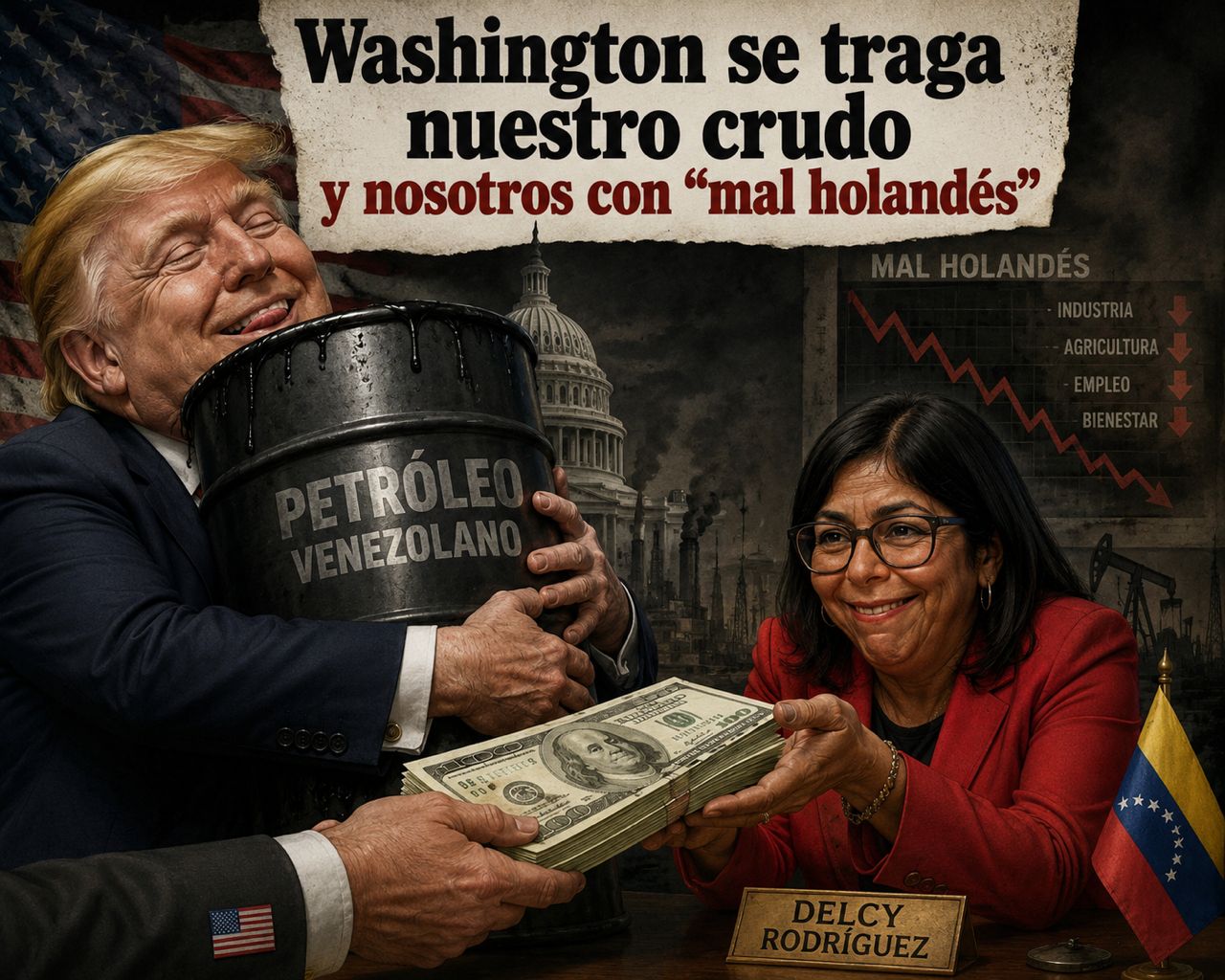
For America's industrial machinery, the oil deal with Venezuela is a tidy package, wrapped in gift paper and tied with a "national security bow."
By guaranteeing a sustained production target of more than 1.5 million barrels per day, refineries in the southern United States resolve their shortage of heavy and extra-heavy crude. Washington secures physical control of the raw material, revitalizes its domestic energy ecosystem and mitigates any volatility from its natural suppliers of gasoline without having to fire a single missile in the Middle East.
But let's focus the lens on Venezuela. Following the oil pact, our country projects gross global revenue of $542 billion, of which the treasury would retain the aforementioned $209.335 billion in taxes and royalties (with a minimum royalty base of 16% and an income tax rate of 34%, known as ISLR), plus $22 billion directly for PDVSA in its capacity as minority partner.
Although such enormous sums sound very encouraging, as so many times throughout our history, we run the risk of the well-known "Dutch disease." This condition describes the damage to a country's economy when a large inflow of foreign currency comes from selling a natural resource. In this sense, Venezuela's contemporary history is a tragic compendium of economic disasters tied to external liquidity booms since the 1950s, because, as the bolívar appreciates on extraordinary inflows of foreign currency, the country's productive sector loses external competitiveness, favoring imports of goods and services and destroying domestic industry.
The financial advantages versus the macroeconomic risk of the oil deal
The advantages: this colossal injection of liquidity represents a unique and definitive opportunity to rebuild the nation's troubled infrastructure. There are ample resources to finance the modernization of the national power grid, water sanitation, ports and high-level technical education, essential elements after a hyperinflation crisis that destroyed 80% of GDP.
The imminent risk: historically, the sudden and massive inflow of petrodollars artificially appreciates the local currency. If these dollars are injected without control into the economy to finance current public spending, subsidies or patronage, imported goods will be cheaper than those produced at home. This will pulverize the already scant competitiveness of our industry and agriculture, returning us to the deadly "port economy" that Venezuela has traditionally lived through.
In short, the oil deal provides the financial resources that absolutely no one else in the international community was willing to lend us, allowing us to avoid the fiscal abyss we are living through. However, it also hands us the weapon with which we could commit macroeconomic suicide. If political leadership gives in to the populist temptation of the short term, we will watch dollars evaporate into luxury imports while our factories close for good. Fiscal discipline is no longer an academic option; it is an imperative for national survival.
Image generated with AI.