Editorial
Venezuelans are great shoppers, from “Mayami Nuestro” to the present day
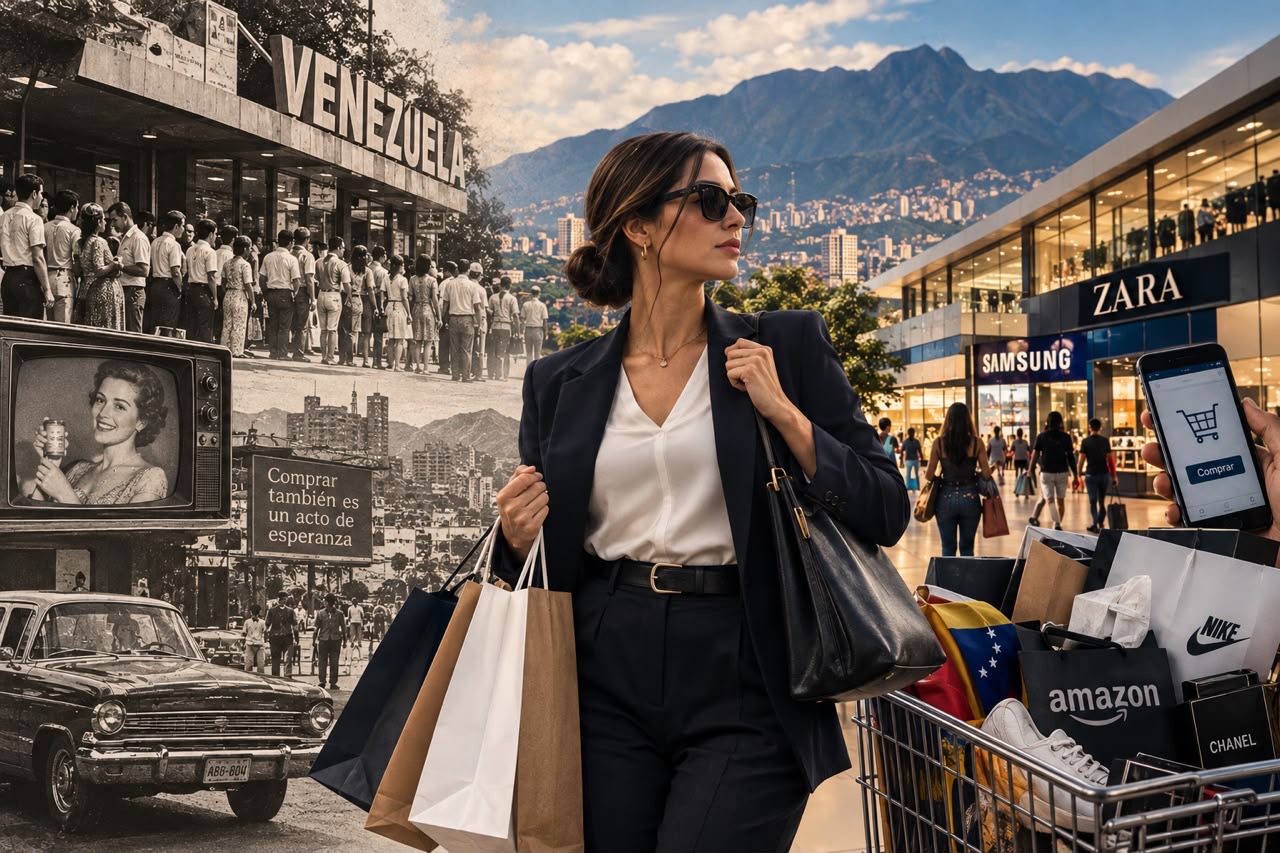
In the social imagination of the twentieth century, Venezuela occupied an insular place in Latin America: that of a prosperous nation floating on an ocean of oil. This condition not only reshaped the country’s macroeconomy but profoundly shaped the collective psychology, lifestyle habits and aspirations of its citizens. In this context, Venezuelan documentary filmmaking found in Carlos Oteyza one of its sharpest analysts. Released in 1981, his medium-length film “Mayami Nuestro” captures the historic hinge between the opulence of the oil boom and the impending economic fracture of the “Viernes Negro” (1983)
Oil rent turned consumption into the cornerstone of modern Venezuelan identity. Through Oteyza’s critical lens, the film examines the fascination with the American lifestyle, the “American Way of Life,” the adoption of travel as a status ritual and the consolidation of purchasing power. The emergence of the Venezuelan rentier state structurally altered the relationship between productive effort and economic reward. Unlike industrial societies, where wealth is linked to work and the production of goods, in Venezuela wealth came from capturing and distributing international oil rent. This phenomenon permeated popular culture with a notion of “inexhaustible” wealth, favoring the overvaluation of the bolívar and opening the door to a heavily import-dependent economy.
Oil functioned as an illusion that disconnected the country’s economic reality from its internal productive dynamics. Mass consumption was not perceived as an occasional privilege but as a right inherent to the condition of a “rich country.” The abundance of foreign exchange led the aspirations of the middle and working classes to quickly reorient toward luxury consumption and the continuous acquisition of imported goods and services.
The commercial boom of the late 1970s and early 1980s gave rise to a sociocultural phenomenon condensed in the famous phrase popularized at the time: “It’s cheap, give me two.” This expression goes beyond mere anecdote and becomes the indicator of compulsive buying behavior fed by the artificial overpricing of the bolívar and the oversupply of foreign goods. In Mayami Nuestro, Carlos Oteyza shows how the city of Miami ceased to be simply a geographic destination and became a cultural and ideological appendage of Caracas. The documentary depicts with stark irony Venezuelan families roaming American shopping malls, buying appliances, suitcases full of clothing and luxury items.
This drive to buy responded to several sociocultural reasons: Social Status: Owning products “brought from the north” or displaying American brands conferred immediate validation before peers. Cultural Neocolonial Influence: The penetration of American cinema, television and advertising built an ideal of social success strictly tied to Western consumption patterns. The Trip as a Rite of Passage: The vacation trip to the United States lost its summer character to become an annual routine of personal restocking and ostentation.
Geographic proximity and trade ties between Venezuela and the United States consolidated a dependence that was not only economic but aspirational. The American Way of Life offered a catalogue of prepackaged modernity that matched the purchasing power of the “Saudi Venezuela” era. In his documentary, Oteyza shows that this fascination produced a distortion in the concept of modernization. While institutions and national infrastructure showed structural cracks, the average citizen measured the country’s progress by the availability of consumer goods and foreign technological innovation. The accumulation of objects became a substitute for active citizenship and sustainable development.
Mayami Nuestro remains an essential founding document for understanding the paradoxes of contemporary Venezuelan society. Carlos Oteyza’s work demonstrates that oil not only financed physical infrastructure but shaped a mental architecture in which consumption became the main expression of national identity. Although the collapse of the rentier model radically transformed the country’s material conditions, the cultural traces of that era—the aspiration to the North American model, the valuation of status through acquisition and the collective memory of “give me two”—continue to resonate in the social dynamics of today’s Venezuelans.
Four decades after this audiovisual material, the mental relationship of Venezuelans with consumption has undergone a complex yet deeply rooted metamorphosis. After years of economic contraction, hyperinflation and shortages, consumption no longer represents the overflowing abundance of “give me two,” but rather a form of social resilience, a store of value and an attempt to restore everyday normalcy.
De facto dollarization and recent trade liberalization have reignited the drive to consume imported goods and Western services. In today’s Venezuela, the ability to buy American products or access emblems of the global lifestyle continues to function as the main marker of wellbeing and socioeconomic status amid the income gap.This revived consumption takes on a strategic dimension in light of the present political moment and Venezuela’s new foreign policy toward the United States. After years of estrangement and diplomatic sanctions, the signing of strategic energy agreements and the easing of licenses by the U.S. Treasury Department (OFAC) for hydrocarbon exploration and private investment mark a pragmatic shift in bilateral relations.
This new diplomatic and energy framework shows that, despite political rhetoric, the oil-consumption axis still dominates Venezuelan geopolitics. The renewed flow of capital and licenses for the oil sector aims to stabilize fiscal revenues and revive trade, once again meeting the demands of a population whose cultural consumption pattern, shaped in the era described by Oteyza, never fully disappeared.