Editorial
Regional lessons from the vote and the return. A Sunday with Lula and María Corina Machado
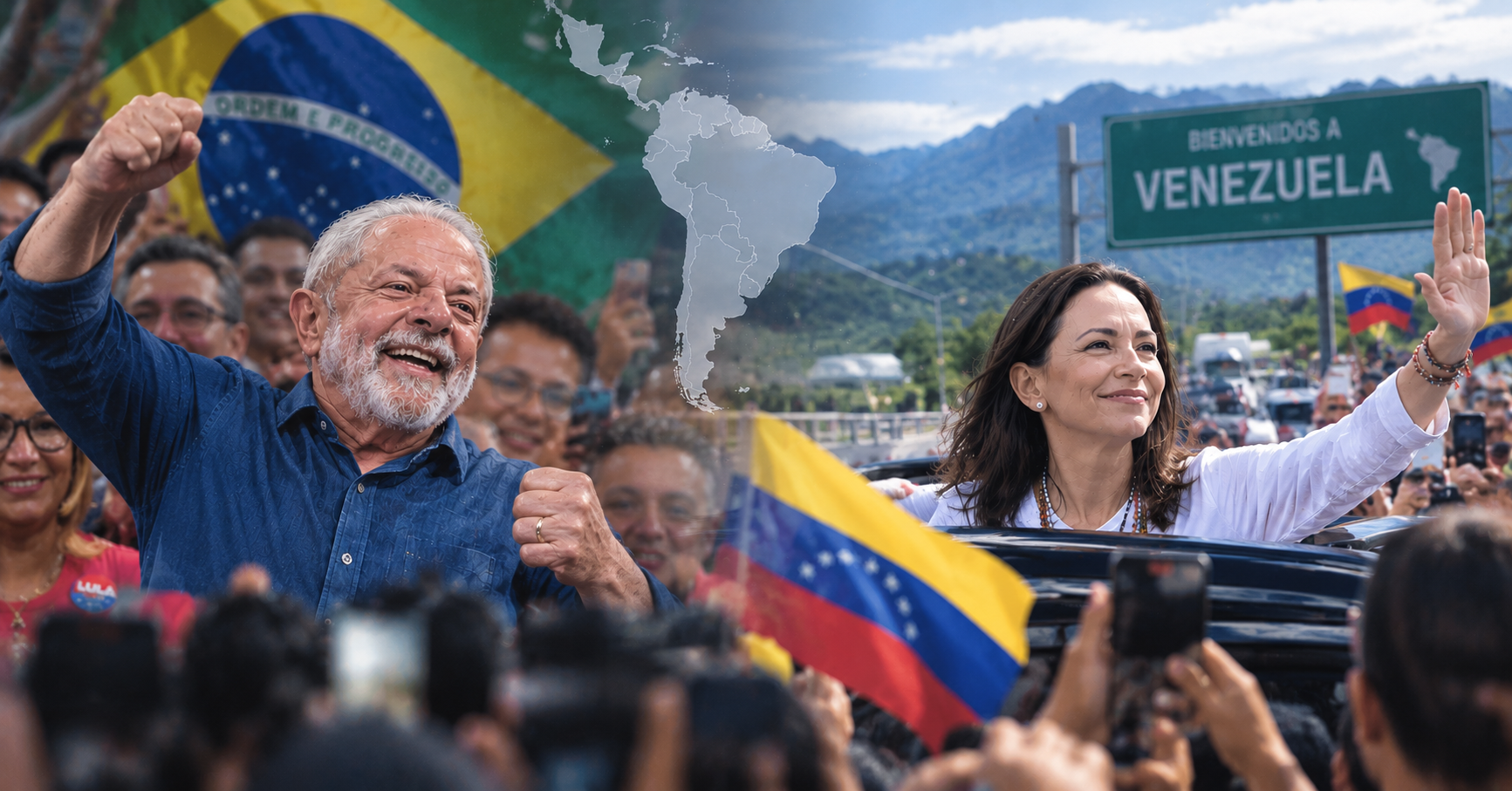
Two Milestones, One Principle
Latin American politics offered a day of profound institutional significance yesterday. In two fundamental geopolitical arenas of the region, Brazil and Venezuela, events took place that differed in their execution but converged in their underlying foundation: the validity and urgency of democratic pillars.
On one side, Brazil reaffirmed the power of the ballot as the legitimate, peaceful and sovereign mechanism for resolving political disputes and for alternating or ratifying power. The election that sealed the renewal of the mandate of Luiz Inácio Lula da Silva demonstrated once again that the strength of a system rests on collective trust in its electoral bodies and on citizens' acceptance of the rules of the democratic game.
On the other side, Venezuela witnessed the return to national soil of opposition leader María Corina Machado. After a period of exile and political uncertainty, her presence in the country embodies an irreplaceable dimension of democracy: the guarantee of political rights, the pluralism of ideas and the freedom for representative actors of society to exercise democratic leadership in their own territory. Moreover, her return is a symbol of hope for millions of Venezuelans who want a profound political change in the country.
Both events are milestones linked by a single underlying premise: there is no economic viability, social stability or sustainable development in Latin America outside of solid institutions and a predictable democratic framework.
The Strength of Institutions and the Value of the Vote
Institutions are neither abstract constructs nor mere bureaucratic formalities; they are the social pact through which a nation establishes the rules of peaceful coexistence. When institutions function, they absorb the tensions of polarization, channel ideological differences and turn social conflicts into civilized debates over public policy.
The vote in Brazil is a testament to the value of free and transparent suffrage. In a highly polarized environment, institutional arbitration allows millions of individual wills to be translated into a legitimate mandate. The lesson drawn from this experience is that normative and ideological differences are processed within the ballot box and through clear rules accepted by all contenders. Coexistence, dialogue and social cohabitation among all political forces: there is no other recipe.
The Venezuelan scenario highlights the imperative need for clear rules that protect plural representation. The return of political leaders to the local arena and the open participation of all political forces are vital to rebuilding certainty, a key element for the recovery of the socioeconomic fabric and for restoring investor confidence. Democracy is, above all, a system of coexistence. It does not imply the absence of conflict, but the unwavering commitment to resolve it without resorting to the exclusion of adversaries, as occurred in Venezuela for many years. Today, it seems, there is a great opportunity to change this reality.
Democratic governance requires bridges, negotiating capacity and reconciliation between opposing sectors. The temptation of political monologue or of marginalizing significant sectors only prolongs instability and blocks the structural reforms the region needs in taxation, infrastructure and poverty reduction. Sunday's events open an important opportunity for political reflection in the region. They remind us that nations prosper not when hegemonic visions are imposed, but when they manage to institutionalize dissent and channel it peacefully through the vote and respect for political freedoms.
Committing to democracy, upholding the irreplaceable value of the vote and ensuring respect for and inclusion of all political sectors are not doctrinal choices, but essential requirements for the material and collective well-being of our societies. Latin America needs strong institutions that can outlast short-term dynamics and guarantee a future in which the only path to power and representativeness is the freely expressed will of its citizens.