News
US public debt tops $40 trillion, latest records show
US public debt hit a new record high by surpassing $40 trillion, according to information published by the Colombian newspaper Elcolombiano on September 2, 2026.
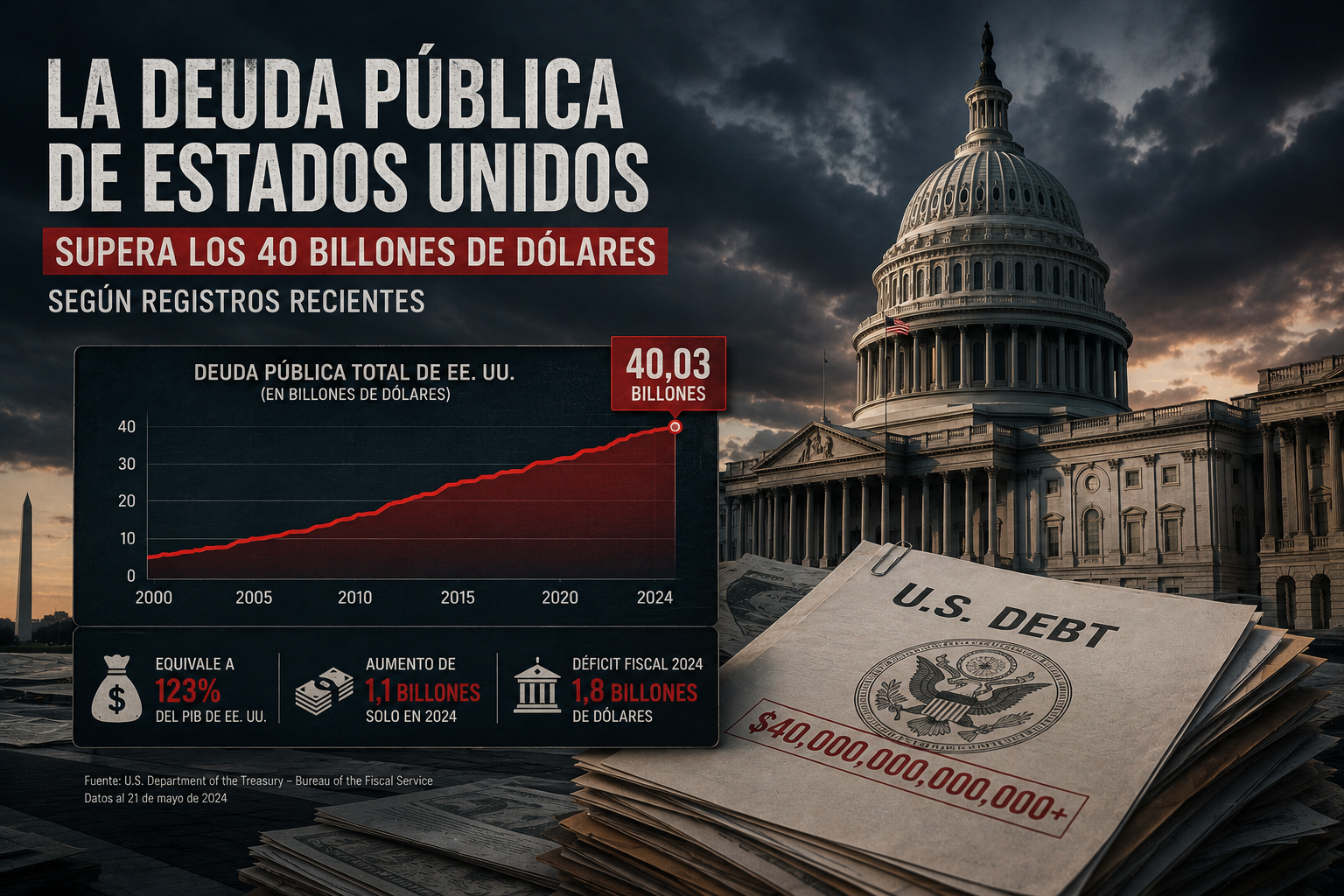
US public debt hit a new record high by surpassing $40 trillion, according to information published by the Colombian newspaper Elcolombiano on September 2, 2026. This level of liabilities is above initial estimates prepared by Congress, exceeding forecasts that put the figure at $39.4 trillion at the close of the fiscal year in September.
To understand the scale of this trend, it is necessary to note that borrowing is the mechanism through which the state covers its obligations when tax revenues are insufficient to sustain federal spending. In this context, the US Treasury Department specified that the total obligation stood at exactly $40.047 trillion. This pace of expansion reflects a sustained increase compared with $38 trillion recorded in October 2025 and $39 trillion reached in March 2026.
The growth of these liabilities reflects structural factors accumulated over recent decades, such as the financing of military operations and responses to earlier global crises. Recent measures were added to these, including tax cuts and changes in tariff collection that temporarily reduced fiscal revenues, along with budgetary requirements stemming from military activity in the Middle East.
As for the implications for the economy, interest payments on this debt now represent the second-largest item of federal spending, surpassed only by Social Security. Although similar shares have historically been recorded during periods of extraordinary mobilization such as World War II, the current fiscal trajectory is generating debate among experts about the long-term sustainability of these liabilities.
Regarding the impact on borrowing costs and citizens' mortgages, analysts note that the transmission to the domestic economy is not automatic, but is mediated by the interest rate decisions adopted by the Federal Reserve and by developments in the sovereign bond market.