News
Venezuela, Argentina, Ecuador and Bolivia share the region's worst country risk
According to a report published by Bloomberg Línea on September 2, 2026, Venezuela, Argentina, Ecuador and Bolivia have the highest levels of country risk in Latin America.
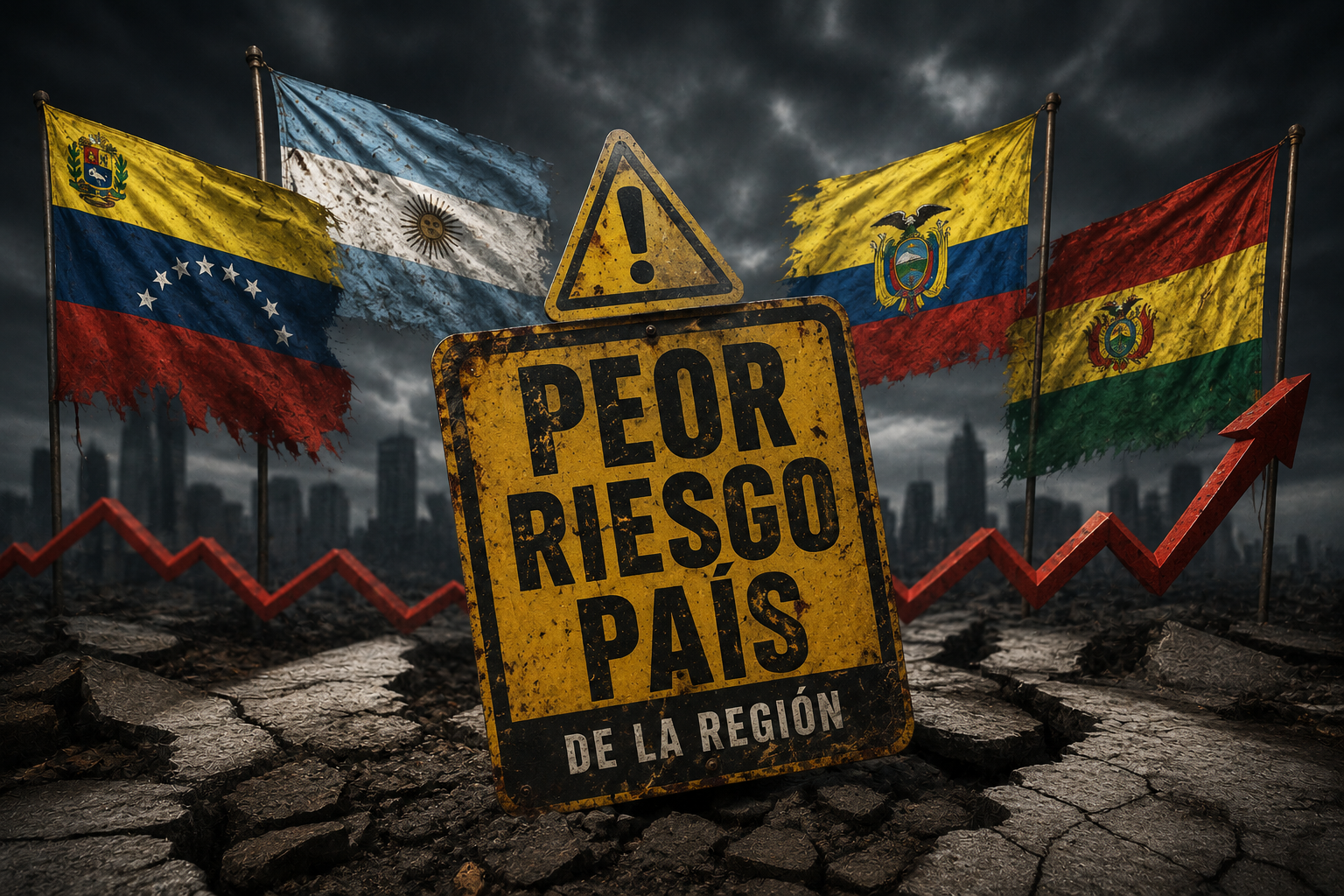
According to a report published by Bloomberg Línea on September 2, 2026, Venezuela, Argentina, Ecuador and Bolivia have the highest levels of country risk in Latin America. The analysis says the situation mainly reflects market perceptions of a shortage of institutional mechanisms capable of containing macroeconomic imbalances before they directly hit investors and the external stability of these nations.
Jonathan Fortun, an economist at the Institute of International Finance (IIF), told the outlet cited that the problem shared by these four countries lies not strictly in the size of their debt or in their specific fiscal position, but in the absence of political and regulatory devices that act as a brake while economic deviation builds up. When this kind of preventive mechanism is missing, the accumulated cost inevitably ends up being shifted onto external creditors.
According to the information disseminated, the economies mentioned exhausted much of their international reserve cushion between 2020 and 2023. With no sufficiently robust domestic fiscal framework or local yield curves capable of absorbing financial shocks, the pressure fell entirely on the external account and international markets, sharply raising risk premiums for each of the governments involved.
In contrast with this scenario, the Bloomberg Línea report highlights that countries such as Chile, Uruguay and Peru show the region's lowest risks, thanks to institutions that manage to anticipate deviations. Meanwhile, in nations such as Brazil and Colombia, imbalances tend to be absorbed domestically through interest rates and exchange rate fluctuations, preventing the cost from spilling over entirely into external debt.
Separately, the regional situation also includes specific industrial developments. According to the agency Descifrado, reporting on the same day, September 2, 2026, the Argentine company Impsa is evaluating expanding its participation in Venezuela's hydroelectric system and plans to submit formal proposals to take on the construction of additional power generation blocks, conditional on progress under its current contract for the Tocoma project.