News
YPF completes historic $1.2 billion debt placement in Argentina
Argentine state-owned company YPF completed a historic debt placement in international markets on September 9, 2026.
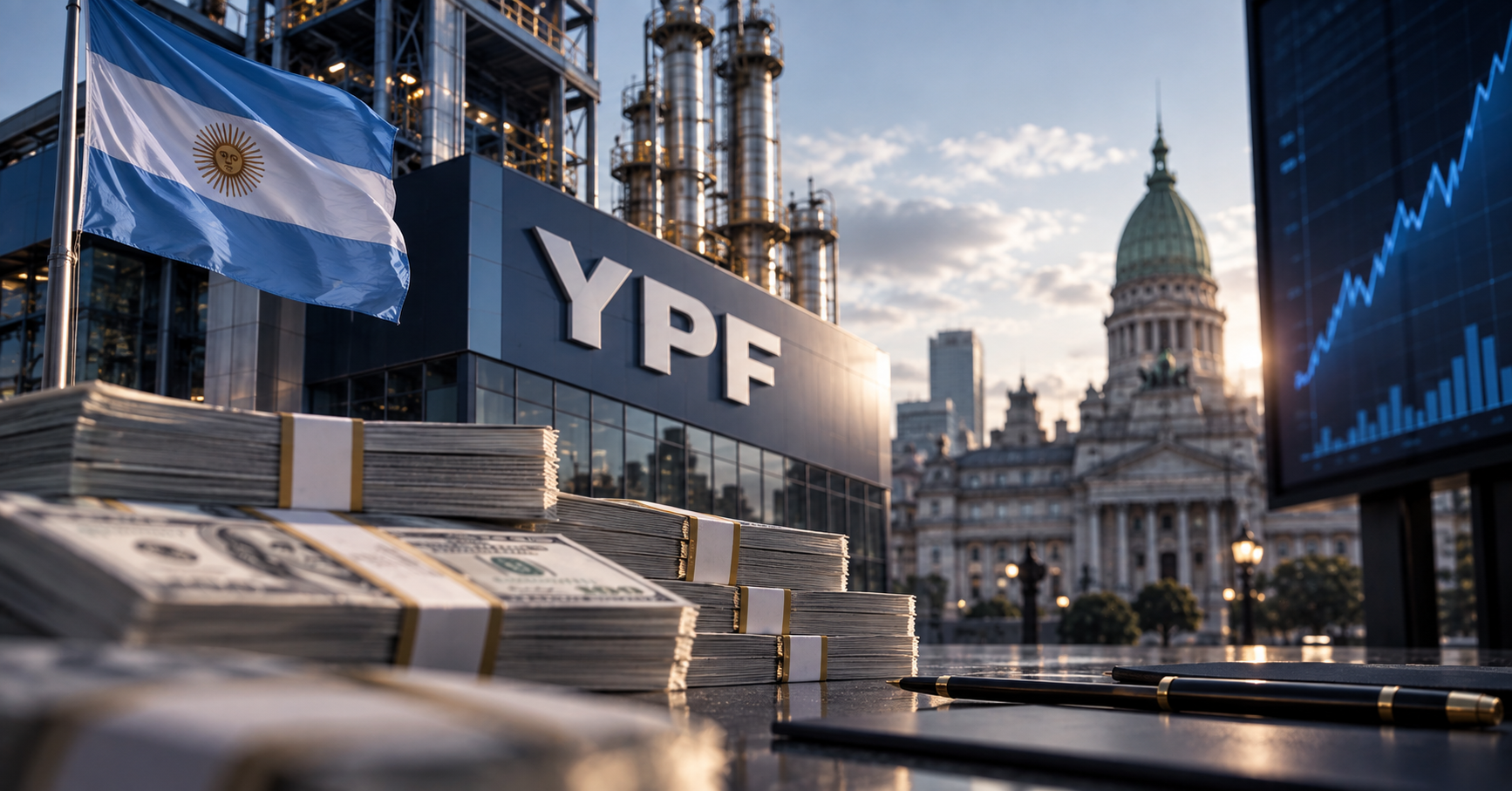
Argentine state-owned company YPF completed a historic debt placement in international markets on September 9, 2026. According to Bloomberg Línea, the oil company placed negotiable obligations (corporate bonds) worth $1.2 billion maturing in 2035. The operation becomes the second-largest debt issuance by the company since 2015, marking a milestone in corporate financing in the country.
Negotiable obligations are private debt instruments that allow companies to obtain direct financing from investors, committing to repay the principal with interest within a set period. In this case, the long-term maturity (2035) gives the oil company considerable room to structure its financial commitments, although it also exposes it to exchange rate fluctuations and global macroeconomic conditions over the next decade.
The placement comes against a backdrop of relative stabilization in Argentina's country risk, as measured by the J.P. Morgan index. The yield spread of this indicator trended downward during the year, falling from 588 basis points in March 2026 to a low of 419 basis points in July 2026. Although the index rebounded to 465 basis points in August 2026, its overall level remains below the highs seen earlier in the year, which facilitated the company's access to international credit markets. A basis point is a unit of financial measurement equal to one hundredth of a percentage point (that is, 0.01%).
For the Argentine economy, a transaction of this size has direct implications for the availability of foreign currency and for market confidence in local corporations. By raising fresh funds abroad, YPF temporarily eases pressure on international reserves, although at the cost of increasing its foreign-currency liabilities. For citizens, the success of this placement may translate into greater operational stability for the country's leading energy company, on which a large part of the fuel supply and the development of key infrastructure depend.
In the coming months, analysts will closely watch how these funds are used and the evolution of international interest rates. It will be crucial to see whether the financing actually translates into higher domestic production or whether, on the contrary, it is used mainly to refinance existing liabilities amid persistent global financial volatility.
Image: The original uploader was Fma12 at English Wikipedia. · Public domain · Wikimedia Commons